
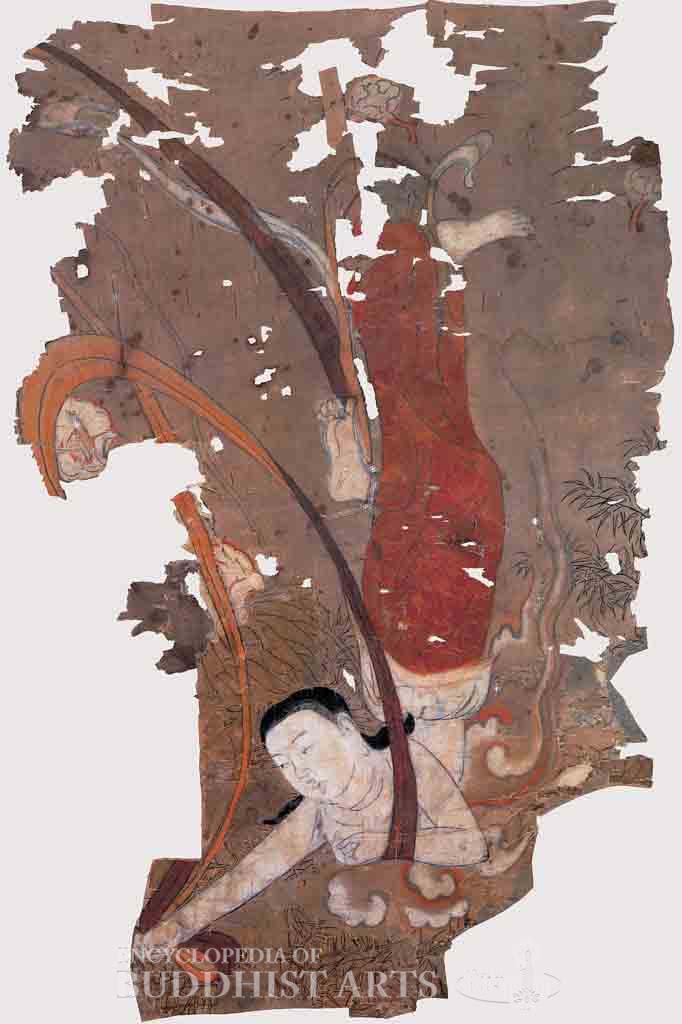
Mogao Cave 17: Apsara
Ink and color on silk
Mogao Cave 17: Apsara
CHINA, Gansu, Dunhuang; Tang dynasty
Dated from the 8th century, this fragment depicts an apsara flying down from the sky. Her brown stole has an orange lining and flutters in the wind. One end of the stole is held in the right hand, while the other is tied around the left wrist. The apsara has white skin and wears a long red dress. Her left leg is extended; the left foot can be seen at the top of the picture. The right foot sticks out from behind the dress, indicating that the right leg is bent. A trail of red and white clouds are painted on the right beside the apsara.
As brown and green plants are visible on the edges of the fragment, the painting was thought to depict the scene of Prince Mahasattva offering his body to the tigress. It was later identified as part of a large Pure Land painting when the mirror image of the apsara was discovered.
For more details, go to the Encyclopedia of Buddhist Arts: Painting I-O, page 540.
Cite this article:
author = Hsingyun and Youheng and Youlu and Wilson, Graham and Manho and Mankuang and Huntington, Susan,
booktitle = {Encyclopedia of Buddhist Arts: Painting I-O},
pages = 540,
title = {{Mogao Cave 17: Apsara}},
volume = 15,
year = {2016}}