
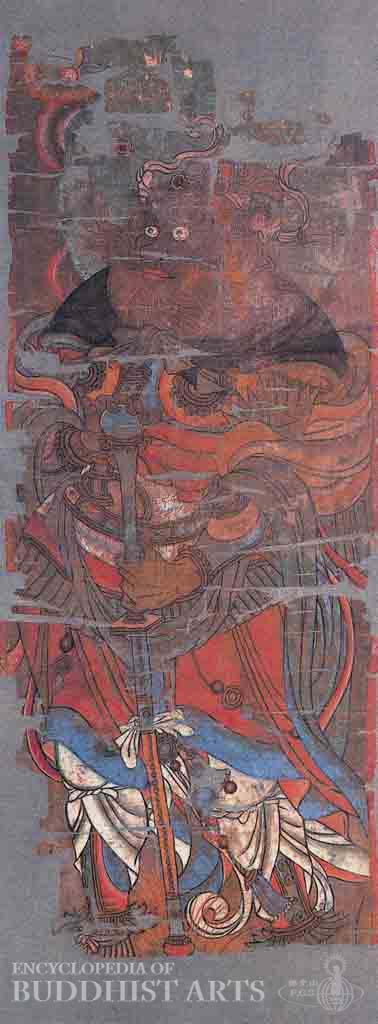
Mogao Cave 17: Virupaksa
Ink and color on silk
Mogao Cave 17: Virupaksa
CHINA, Gansu, Dunhuang; Tang dynasty
This banner was discovered in Mogao Cave 17. Although it has been seriously damaged, with both the headpiece and bottom portion missing, the central figure is still visible. The heavyset Virupaksa, Heavenly King of the West, has wide, staring eyes and a bushy beard. He holds an ornate sword with both hands. The white knots tied below his knees are vividly depicted using shading. Sparse red hair sticking up in the middle of the bottom register likely belongs to a cringing demon trapped under the feet of the Heavenly King.
For more details, go to the Encyclopedia of Buddhist Arts: Painting I-O, page 685.
Cite this article:
Hsingyun, et al. "Mogao Cave 17: Virupaksa." Encyclopedia of Buddhist Arts: Painting I-O, vol. 15, 2016, pp. 685.
Hsingyun, Youheng, Youlu, Graham Wilson, Manho, Mankuang, and Susan Huntington. 2016. "Mogao Cave 17: Virupaksa" In Encyclopedia of Buddhist Arts: Painting I-O, 15:685.
Hsingyun, Youheng, Youlu, Wilson, G., Manho, Mankuang, & Huntington, S.. (2016). Mogao Cave 17: Virupaksa. In Encyclopedia of Buddhist Arts: Painting I-O (Vol. 15, pp. 685).
@misc{Hsingyun2016,
author = Hsingyun and Youheng and Youlu and Wilson, Graham and Manho and Mankuang and Huntington, Susan,
booktitle = {Encyclopedia of Buddhist Arts: Painting I-O},
pages = 685,
title = {{Mogao Cave 17: Virupaksa}},
volume = 15,
year = {2016}}
author = Hsingyun and Youheng and Youlu and Wilson, Graham and Manho and Mankuang and Huntington, Susan,
booktitle = {Encyclopedia of Buddhist Arts: Painting I-O},
pages = 685,
title = {{Mogao Cave 17: Virupaksa}},
volume = 15,
year = {2016}}