
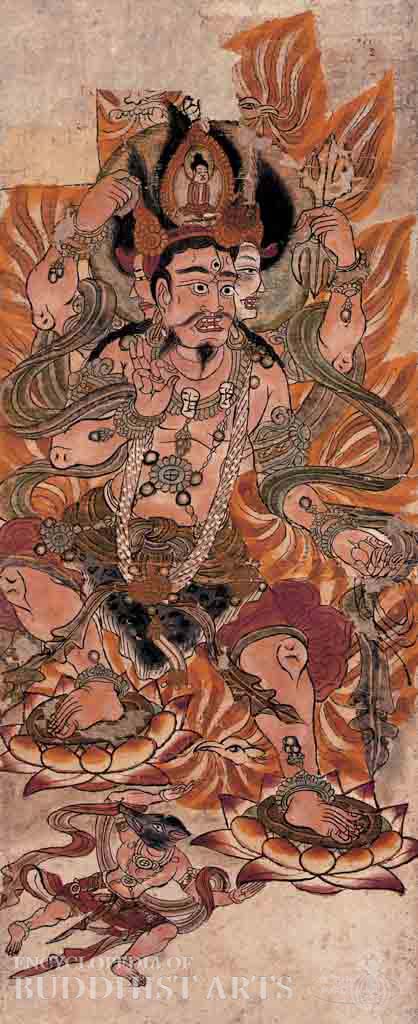
Mogao Cave 17: Ucchusma
Ink and color on paper
Mogao Cave 17: Ucchusma
CHINA, Gansu, Dunhuang; Tang dynasty
This painting of Ucchusma is very similar to an image of Hayagriva that was also discovered in Mogao Cave 17. There was a bamboo pole on the upper edge and a wooden spindle at the bottom when Aurel Stein, the British explorer, acquired this painting, suggesting that it was meant for hanging. Both paintings were possibly the side panels for a larger artwork. Ucchusma wears a crown with a Buddha image centered above his three heads. Covered with ornaments and stoles, he stands on lotuses, holding a vajra in one of his four hands. A figure with an animal’s head and a human body is depicted in the lower register.
For more details, go to the Encyclopedia of Buddhist Arts: Painting I-O, page 679.
Cite this article:
Hsingyun, et al. "Mogao Cave 17: Ucchusma." Encyclopedia of Buddhist Arts: Painting I-O, vol. 15, 2016, pp. 679.
Hsingyun, Youheng, Youlu, Graham Wilson, Manho, Mankuang, and Susan Huntington. 2016. "Mogao Cave 17: Ucchusma" In Encyclopedia of Buddhist Arts: Painting I-O, 15:679.
Hsingyun, Youheng, Youlu, Wilson, G., Manho, Mankuang, & Huntington, S.. (2016). Mogao Cave 17: Ucchusma. In Encyclopedia of Buddhist Arts: Painting I-O (Vol. 15, pp. 679).
@misc{Hsingyun2016,
author = Hsingyun and Youheng and Youlu and Wilson, Graham and Manho and Mankuang and Huntington, Susan,
booktitle = {Encyclopedia of Buddhist Arts: Painting I-O},
pages = 679,
title = {{Mogao Cave 17: Ucchusma}},
volume = 15,
year = {2016}}
author = Hsingyun and Youheng and Youlu and Wilson, Graham and Manho and Mankuang and Huntington, Susan,
booktitle = {Encyclopedia of Buddhist Arts: Painting I-O},
pages = 679,
title = {{Mogao Cave 17: Ucchusma}},
volume = 15,
year = {2016}}