
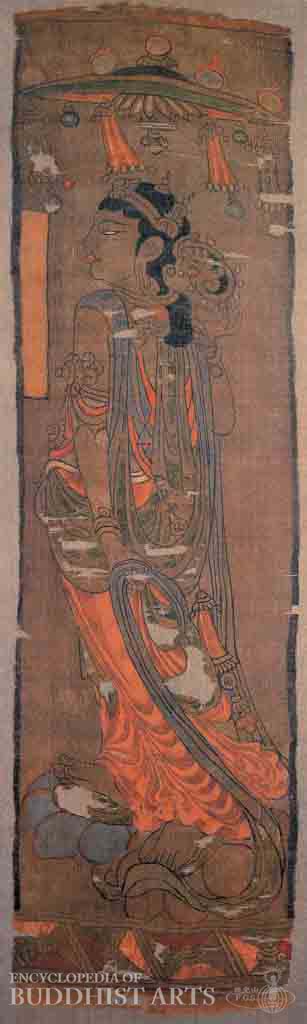
Mogao Cave 17: Standing Bodhisattva
Ink and color on silk
Mogao Cave 17: Standing Bodhisattva
CHINA, Gansu, Dunhuang; Tang dynasty
This painting from the late 9th century was discovered in Mogao Cave 17. The Bodhisattva is portrayed with the back to the viewer and the face in profile. The posture of the figure and the slant of the fringes of the canopy give the impression of motion. The Bodhisattva has a high-bridged nose, deep-set eyes, and dark skin. A crown is worn around the topknot. The body is adorned with ornaments and a blue stole. The folds on the dhoti are highlighted with shading. The right hand is raised, holding a lotus bud, while the left hand is extended downwards grasping a stole. The hips jut out slightly to one side. With one foot raised, the Bodhisattva appears to walk forward on lotus pedestals. Despite the markedly Indian appearance of the figure, the clothing and the blank cartouche suggest that this painting was done by a Chinese artist.
For more details, go to the Encyclopedia of Buddhist Arts: Painting I-O, page 657.
Cite this article:
author = Hsingyun and Youheng and Youlu and Wilson, Graham and Manho and Mankuang and Huntington, Susan,
booktitle = {Encyclopedia of Buddhist Arts: Painting I-O},
pages = 657,
title = {{Mogao Cave 17: Standing Bodhisattva}},
volume = 15,
year = {2016}}