
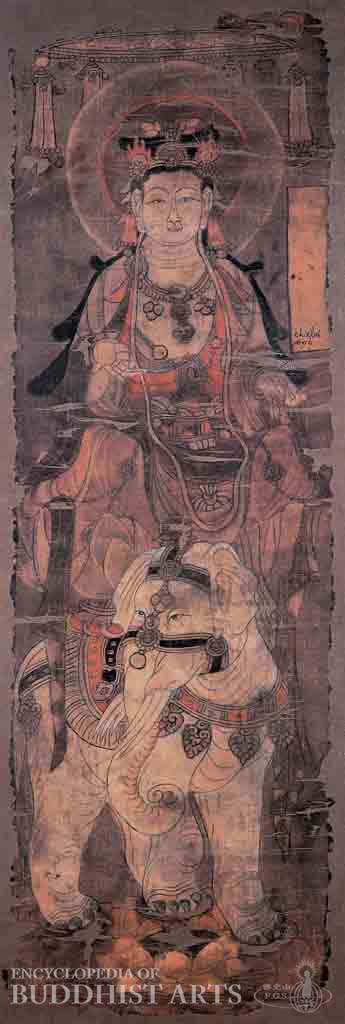
Mogao Cave 17: Samantabhadra Bodhisattva
Ink and color on silk
Mogao Cave 17: Samantabhadra Bodhisattva
CHINA, Gansu, Dunhuang; Tang dynasty
This late 8th to early 9th century painting was discovered in Mogao Cave 17. Samantabhadra Bodhisattva forms the varada (wish-granting) mudra with both hands and sits in a relaxed pose on the back of a six-tusked elephant. The Bodhisattva wears a fluttering stole and a crown decorated with ribbons. The elephant appears to be in motion, with a forefoot raised above a white lotus pedestal.
For more details, go to the Encyclopedia of Buddhist Arts: Painting I-O, page 650.
Cite this article:
Hsingyun, et al. "Mogao Cave 17: Samantabhadra Bodhisattva." Encyclopedia of Buddhist Arts: Painting I-O, vol. 15, 2016, pp. 650.
Hsingyun, Youheng, Youlu, Graham Wilson, Manho, Mankuang, and Susan Huntington. 2016. "Mogao Cave 17: Samantabhadra Bodhisattva" In Encyclopedia of Buddhist Arts: Painting I-O, 15:650.
Hsingyun, Youheng, Youlu, Wilson, G., Manho, Mankuang, & Huntington, S.. (2016). Mogao Cave 17: Samantabhadra Bodhisattva. In Encyclopedia of Buddhist Arts: Painting I-O (Vol. 15, pp. 650).
@misc{Hsingyun2016,
author = Hsingyun and Youheng and Youlu and Wilson, Graham and Manho and Mankuang and Huntington, Susan,
booktitle = {Encyclopedia of Buddhist Arts: Painting I-O},
pages = 650,
title = {{Mogao Cave 17: Samantabhadra Bodhisattva}},
volume = 15,
year = {2016}}
author = Hsingyun and Youheng and Youlu and Wilson, Graham and Manho and Mankuang and Huntington, Susan,
booktitle = {Encyclopedia of Buddhist Arts: Painting I-O},
pages = 650,
title = {{Mogao Cave 17: Samantabhadra Bodhisattva}},
volume = 15,
year = {2016}}