
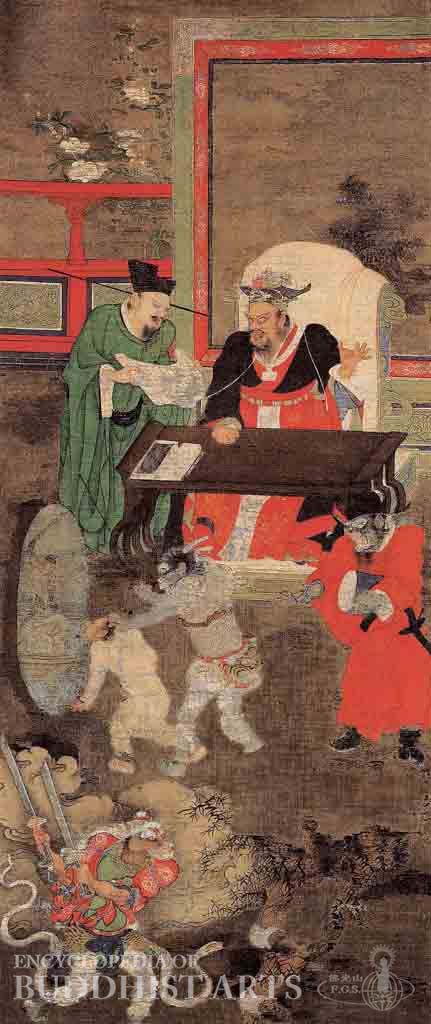
Ten Kings of Hell - King Yama
Ten Kings of Hell
Ten Kings of Hell

Ten Kings of Hell

Ten Kings of Hell

Ten Kings of Hell

Ten Kings of Hell

Ten Kings of Hell

Ten Kings of Hell (location unknown)

Ten Kings of Hell
CHINA; Southern Song dynasty
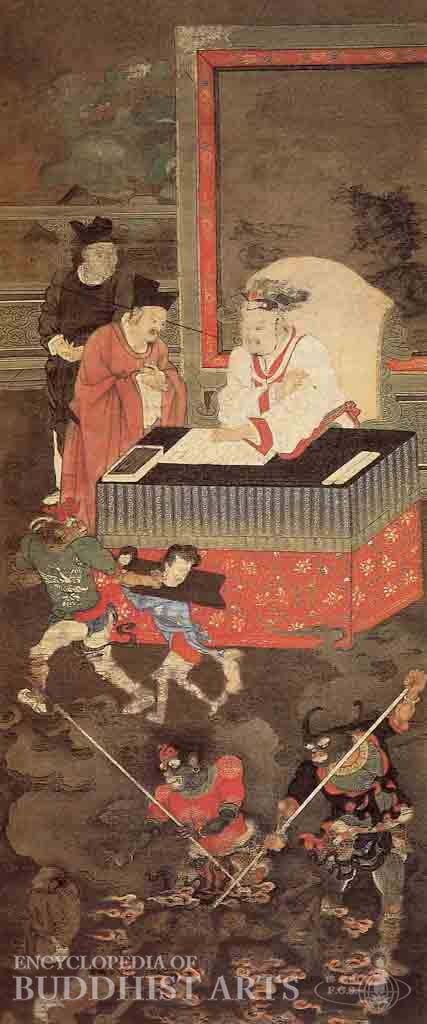
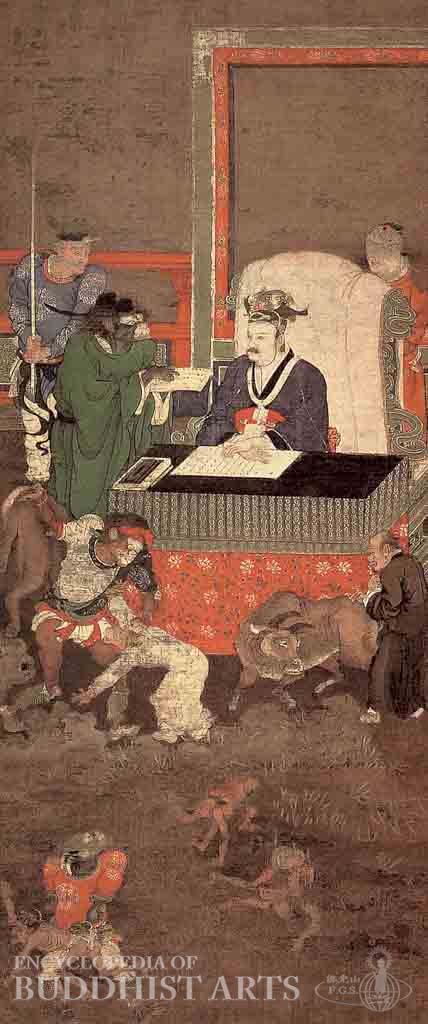
The signature on these paintings of the Ten Kings of Hell reads “Jin Chushi, Mingzhou, Song dynasty.” Mingzhou (present day Ningbo, Zhejiang) was renamed Qingyuan in 1195. Thus, these artworks were made sometime before that date. There are currently nine paintings remaining from the set of ten. They were brought to the USA from Japan during the early 20th century. Five of the paintings, each measuring 111.8 cm high and 47.6 cm wide, are kept in the Metropolitan Museum of Art. The other four, each measuring 107.5 cm high and 47.4 cm wide, are in the Museum of Fine Arts, Boston.
According to the Sutra on the Ten Kings of Hell, all deceased beings travel to the underworld to be judged by the Ten Kings. In each of the paintings, an imposing king sits behind a desk, accompanied by attendants dressed in official’s robes. Below, beings are brought forward for judgment and condemned to terrible punishments. One picture shows a blue hell guardian forcing a man to look into the mirror of karmic deeds. King Yama sits in the upper register, appearing to shout in anger as he condemns the man to be punished for his evil action. In the lower register, a horse-headed figure with a snake wrapped around his waist brandishes two swords and chases after terrified beings. The screen behind King Yama shows images in ink which are indicative of the painting style during the Song dynasty (960–1279). The paintings are brightly colored and filled with an array of vivid figures. The combination of the dignified kings, the frightening guardians, and the pitiful condemned beings makes for interesting compositions.
For more details, go to the Encyclopedia of Buddhist Arts: Painting P-Z, page 895.
Cite this article:
author = Hsingyun and Youheng and Youlu and Wilson, Graham and Manho and Mankuang and Huntington, Susan,
booktitle = {Encyclopedia of Buddhist Arts: Painting P-Z},
pages = 895,
title = {{Ten Kings of Hell}},
volume = 16,
year = {2016}}