
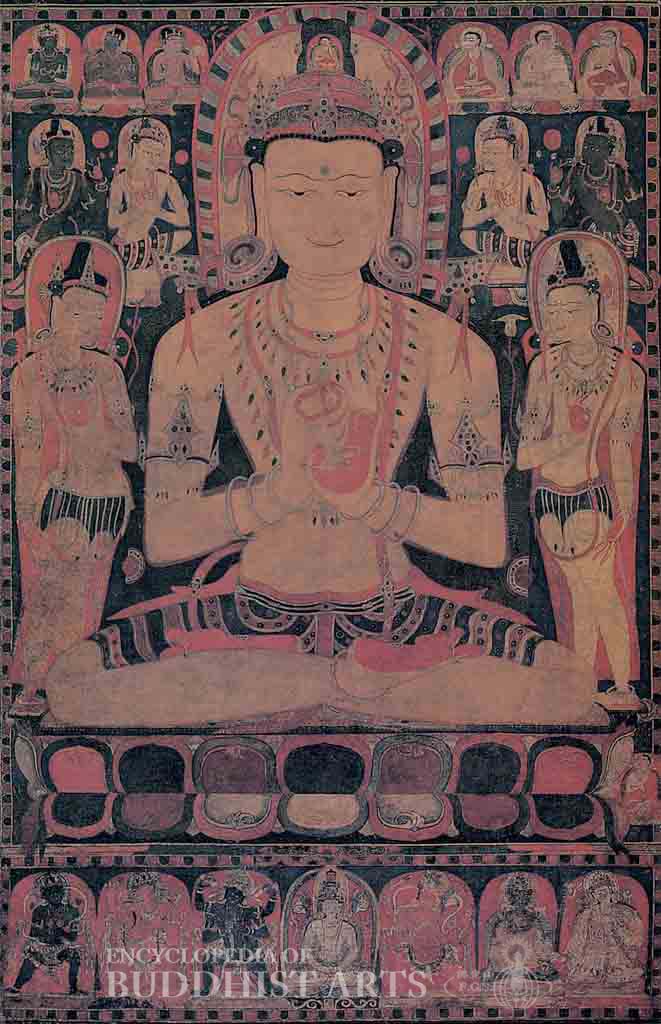
Vairocana Buddha
Color on cotton
Vairocana Buddha
CHINA, Tibet
Vairocana Buddha has a high topknot and wears a distinctive tiered crown topped with an image of a seated monk, probably Phagmo Drupa Dorje Gyalpo of the Kagyu school. The curved eyes of the Buddha reflect the influence of Pala period (circa 8th–12th century) art. A petal-shaped nimbus surrounds the head. The red-palmed hands form the bodhyangi (wisdom fist) mudra; a small vajra, the symbol of Vairocana’s realm, is held between the thumb and index finger of the right hand. The Buddha sits in full lotus position on a lotus throne with colorful petals. Two slender attendant Bodhisattvas stand beside Vairocana. Above each of these figures, two more Bodhisattvas kneel and look towards the Buddha. The row of six figures at the top of the painting represents the lineage of the Kagyu school. Moving from left to right there are depictions of Vajradhara, Tilopa, Naropa, Marpa, Milarepa, and Gampopa. The seven figures at the bottom of the painting are Vajrapani, Vajrayogini, Mahakala, Avalokitesvara, Hayagriva, Vajrasattva, and a warrior.
For more details, go to the Encyclopedia of Buddhist Arts: Painting P-Z, page 953.
Cite this article:
author = Hsingyun and Youheng and Youlu and Wilson, Graham and Manho and Mankuang and Huntington, Susan,
booktitle = {Encyclopedia of Buddhist Arts: Painting P-Z},
pages = 953,
title = {{Vairocana Buddha}},
volume = 16,
year = {2016}}