
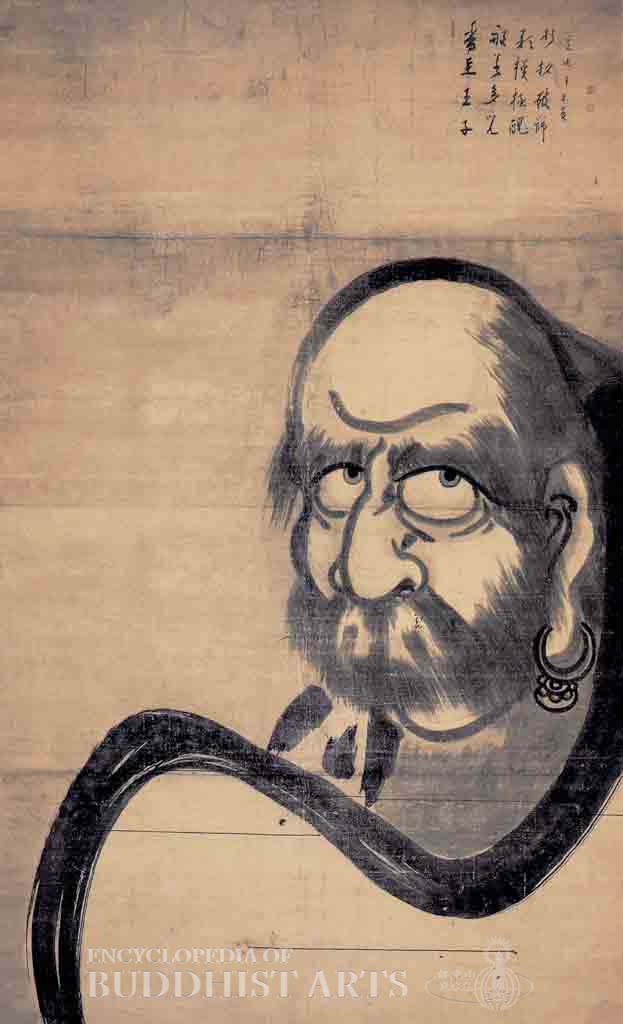
Bodhidharma
Ink on paper
Shosoji Temple: Bodhidharma
JAPAN, Aichi, Toyohashi; Edo period
This Edo period artwork depicts Bodhidharma, an Indian monk who traveled to China during the rule of Emperor Wu (reigned 502–549) and became the First Patriarch of the Chan school. The inscription in the upper right corner includes information from Bodhidharma’s biography in the Transmission of the Lamp and dates the painting to 1751, when the artist Hakuin Ekaku was approximately 60 years old.
The picture is composed of four pieces of paper glued together. Bodhidharma’a facial features are depicted with thick lines of light ink. He has a bare head, an unkempt beard, long eyebrows, and a hooked nose. His wide eyes gaze upwards; his enigmatic expression seems to express deep realization. A single line is painted on the forehead. The robe is depicted with three short strokes below the chin and a long, rapidly painted line that extends into the lower left corner. The minimalistic, swift brushwork, emblematic of the artist’s unique Zen style, gives the painting a sense of liveliness and energy.
For more details, go to the Encyclopedia of Buddhist Arts: Painting P-Z, page 834.
Cite this article:
author = Hsingyun and Youheng and Youlu and Wilson, Graham and Manho and Mankuang and Huntington, Susan,
booktitle = {Encyclopedia of Buddhist Arts: Painting P-Z},
pages = 834,
title = {{Shosoji Temple: Bodhidharma}},
volume = 16,
year = {2016}}