
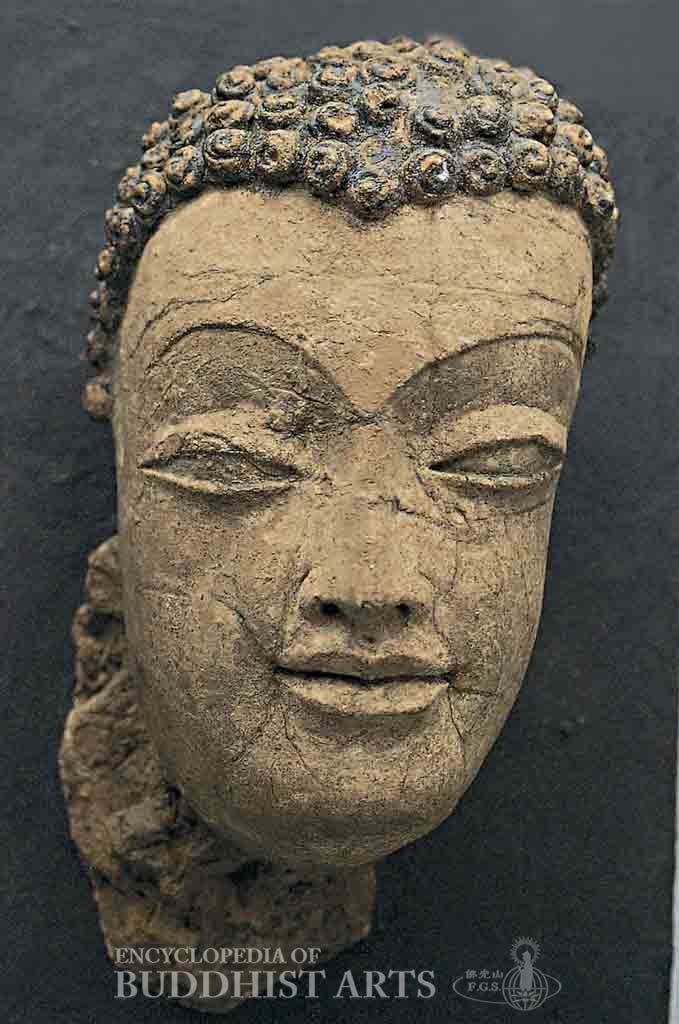
Ajina Tepe: Head of a Buddha
Clay

Ajina Tepe: Head of a Buddha (side)
Ajina Tepe: Head of a Buddha
TAJIKISTAN, Khatlon
Unearthed from the ruins of Ajina Tepe in Tajikistan, this head is a realistic portrayal of the facial features of the people living in the area at that time. The top of the head is smooth, as if shaven, with protrusions that scholars believe might represent some type of head covering. The eyebrows are closely placed and the wide eyes stare foreward. The earlobes show evidence of having once worn jewelry. The nose is prominent while the lips are firmly pressed together. There is evidence that the sculpture was once painted. Experts believe that the face may have been colored yellow, the eyebrows black, while other features were painted red.
For more details, go to the Encyclopedia of Buddhist Arts: Sculpture A-F, page 6.
Cite this article:
Hsingyun, et al. "Ajina Tepe: Head of a Buddha." Encyclopedia of Buddhist Arts: Sculpture A-F, vol. 10, 2016, pp. 6.
Hsingyun, Youheng, Yann Lovelock, Yuan Chou, Susan Huntington, Gary Edson, and Robert Neather. 2016. "Ajina Tepe: Head of a Buddha" In Encyclopedia of Buddhist Arts: Sculpture A-F, 10:6.
Hsingyun, Youheng, Lovelock, Y., Chou, Y., Huntington, S., Edson, G., & Neather, R.. (2016). Ajina Tepe: Head of a Buddha. In Encyclopedia of Buddhist Arts: Sculpture A-F (Vol. 10, pp. 6).
@misc{Hsingyun2016,
author = Hsingyun and Youheng and Lovelock, Yann and Chou, Yuan and Huntington, Susan and Edson, Gary and Neather, Robert,
booktitle = {Encyclopedia of Buddhist Arts: Sculpture A-F},
pages = 6,
title = {{Ajina Tepe: Head of a Buddha}},
volume = 10,
year = {2016}}
author = Hsingyun and Youheng and Lovelock, Yann and Chou, Yuan and Huntington, Susan and Edson, Gary and Neather, Robert,
booktitle = {Encyclopedia of Buddhist Arts: Sculpture A-F},
pages = 6,
title = {{Ajina Tepe: Head of a Buddha}},
volume = 10,
year = {2016}}