
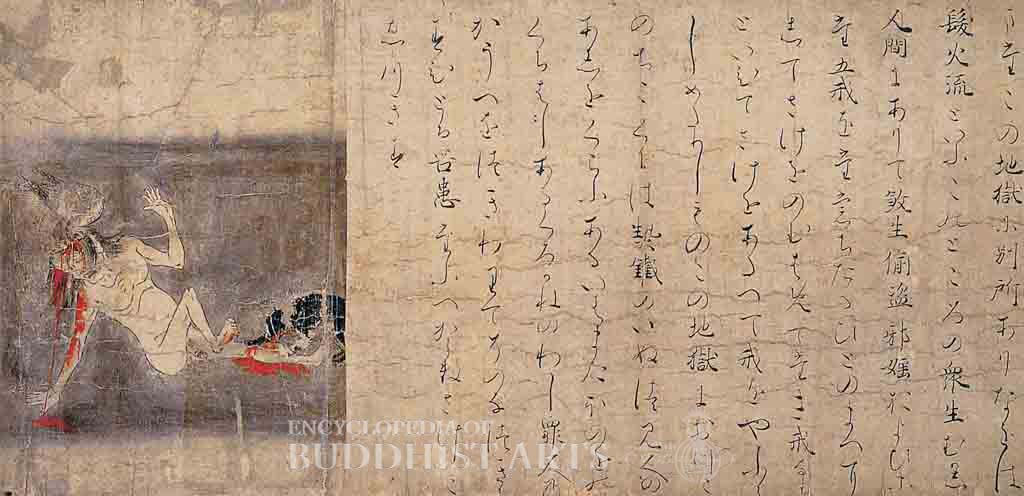
Scroll of the Hells - Hell of Iron Vultures and Dogs
Ink and color on paper
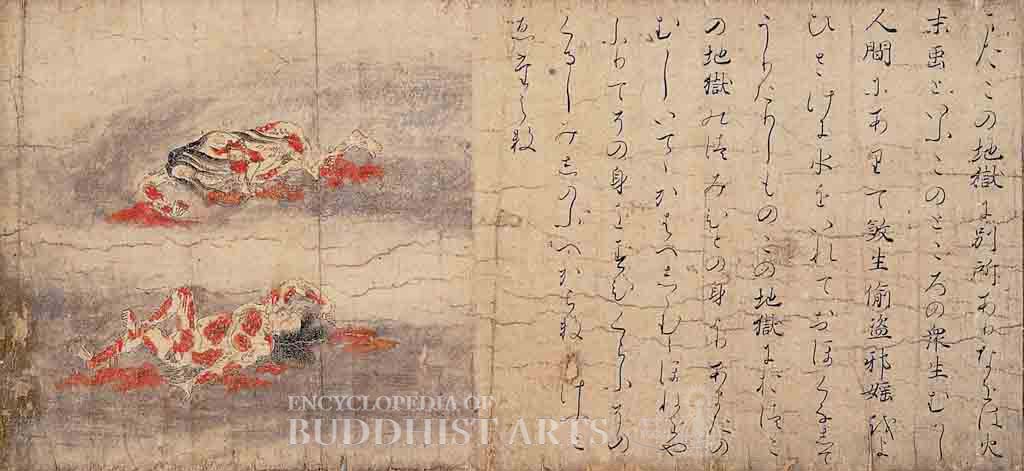
Scroll of the Hells - Hell of Maggots
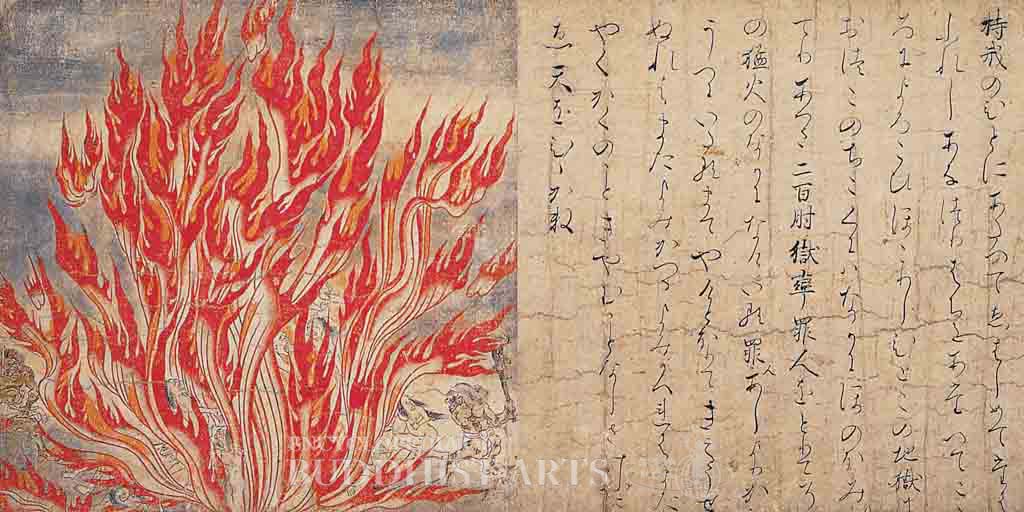
Scroll of the Hells - Hell of Fire
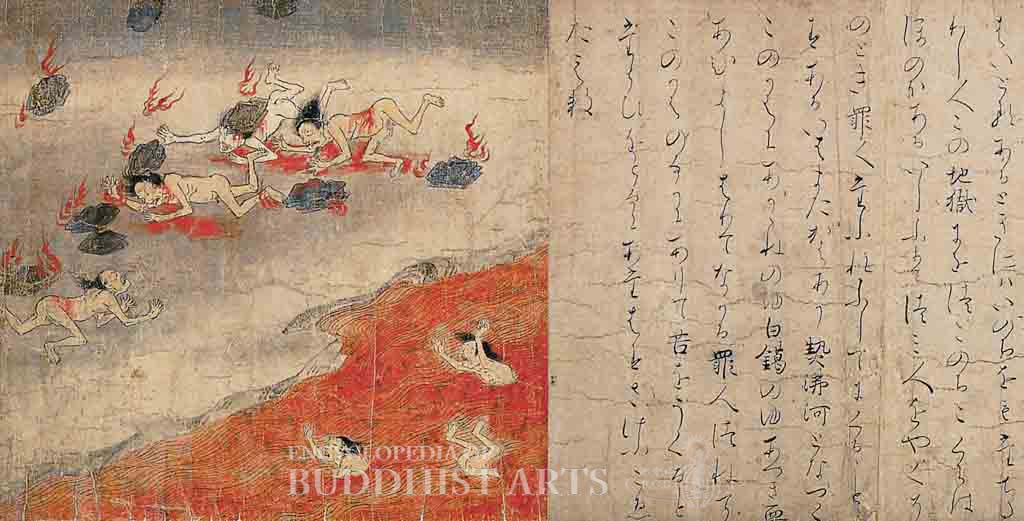
Scroll of the Hells - Hell of Fiery Rocks
Scroll of the Hells
JAPAN; Kamakura period
Painted according to descriptions in the Saddharma Smrtyupasthana Sutra, this scroll portrays different parts of the hell realm. It was produced in the 12th century, making it one of the first Scrolls of the Hells made in Japan, likely part of a larger work depicting the six realms of existence kept in the collection of Emperor Go-Shirakawa (reigned 1155–1158) in Sanjusangendo Temple, Kyoto. The scroll was listed as a National Treasure of Japan in 1956 and is presently stored in the Tokyo National Museum.
Belief in rebirth in one of the six realms of existence was prevalent in Japan during the years of war from the end of the Heian period (794–1185) to the early Kamakura period (1185–1333). Life was difficult and could even be described as hellish at times. Works like the Scroll of Hungry Ghosts and Scroll of the Hells emerged from such a background.
The scroll is 26.1 cm high and 240 cm long, and is divided into four scenes paired with descriptions. The Hell of Iron Vultures and Dogs is for people who committed acts of murder, theft, sexual misconduct, and the taking of intoxicants during their lives. The inhabitants are burned by a rain of fire, their feet are gnawed by iron dogs, and their skulls are crushed and devoured by iron vultures. In the Hell of Maggots, which incarcerates those who sold intoxicants or cheated in trades, the inhabitants suffer from 404 diseases, infestation by maggots that feed into the bones and marrow, and severe burns from raging fires.
The Hell of Fire confines those who influenced precepts-abiding persons into the taking of intoxicants. The inhabitants of this hell are haunted by raksasas, who repeatedly chase them into a great fire. Their bodies are burnt completely to ashes and then restored so they can be burned again. The painting uses strong, curving lines and a balance of both thick crimson and light red to represent the violent tongues of fire flaring upwards. The Hell of Fiery Rocks is inhabited by people who forced drinks upon someone, made them drunk, and then stole their belongings or murdered them. They are stoned by fiery rocks, or are cooked in a boiling river of molten copper and blood. The pictures are primarily colored in red and black, with certain parts lightly washed in ink for accentuation. Skillful brushwork and crisp lines are used to evoke a vivid, horrifying atmosphere.
For more details, go to the Encyclopedia of Buddhist Arts: Painting P-Z, page 796.
Cite this article:
author = Hsingyun and Youheng and Youlu and Wilson, Graham and Manho and Mankuang and Huntington, Susan,
booktitle = {Encyclopedia of Buddhist Arts: Painting P-Z},
pages = 796,
title = {{Scroll of the Hells}},
volume = 16,
year = {2016}}