
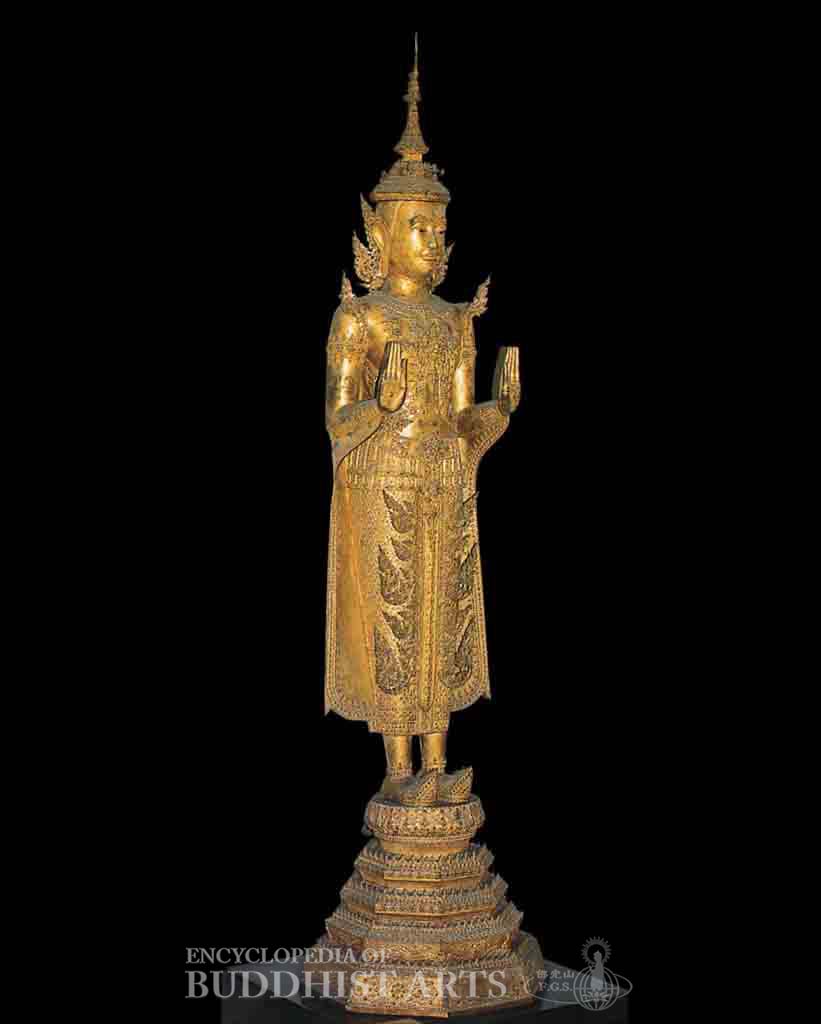
Crowned Buddha
Gilt bronze
Crowned Buddha
THAILAND; Bangkok period
King Rama I (reigned 1782–1809) started actively promoting Buddhist architecture and sculpture as soon as he ascended the throne. This led to a flourishing of Buddhist art in Thailand which was later designated the Bangkok period (1782–present).
The Buddha is depicted in this sculpture as a member of royalty and wears the royal crown of Thailand, with the distinctive leafy ornamentation fanning out from the back of the head. He has a round face, downcast eyes, small nose, wide mouth, noble chin, and elongated earlobes. He has a number of necklaces together with shoulder ornamentation, armlets, bracelets and anklets. The highly decorated sampot is adorned with emeralds along the edges. The sampot is secured in place by a thick belt with a tassel with a leafy design spreading to either side. Both hands are raised to form the abhaya (fearlessness) mudra. The figure stands on a lotus pedestal supported by a four-tier octagonal base.
For more details, go to the Encyclopedia of Buddhist Arts: Sculpture A-F, page 270.
Cite this article:
author = Hsingyun and Youheng and Lovelock, Yann and Chou, Yuan and Huntington, Susan and Edson, Gary and Neather, Robert,
booktitle = {Encyclopedia of Buddhist Arts: Sculpture A-F},
pages = 270,
title = {{Crowned Buddha}},
volume = 10,
year = {2016}}