
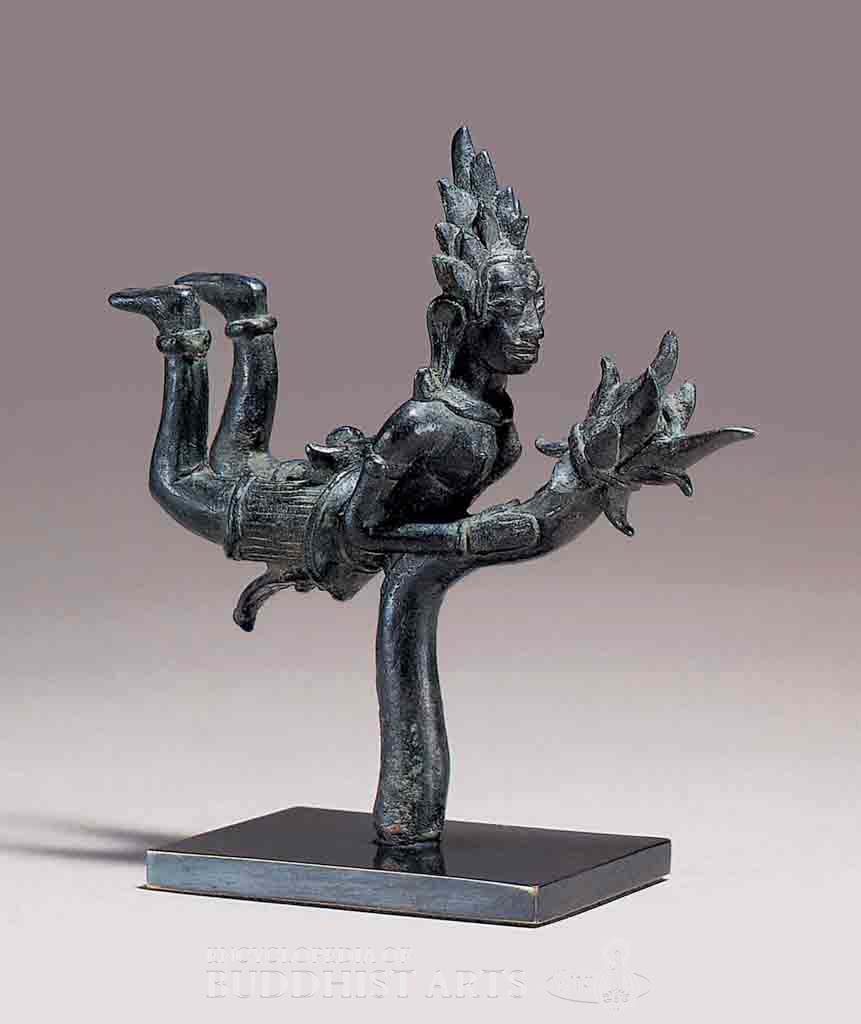
Lamphun: Apsara
Bronze
Lamphun: Apsara
THAILAND, Lamphun
Lamphun, the present location of ancient Haripunchai (circa mid-7th century–1292), was at first influenced by the art of the Mon people and the Dvaravati Kingdom (circa 6th–13th century) but by the 8th century had developed a style unique to itself.
Believed to have been part of a much larger sculpture, the being is attached to the lotus stalk at the navel. The feet and torso are bent upward as the figure holds onto the stalk with both hands, seemingly afloat. The Apsara’s headdress is made of lotus petals that ascend in a triangular shape, beneath which are circular ear ornaments and other jewelry. The facial features include the large eyes, straight nose and prominent lips common to this location. The upper body is bare but the figure wears a short skirt that is secured at the waist with a belt. The front of the belt hangs downwards while the back is tied in a bow.
For more details, go to the Encyclopedia of Buddhist Arts: Sculpture G-M, page 577.
Cite this article:
author = Hsingyun and Youheng and Lovelock, Yann and Chou, Yuan and Huntington, Susan and Edson, Gary and Neather, Robert,
booktitle = {Encyclopedia of Buddhist Arts: Sculpture G-M},
pages = 577,
title = {{Lamphun: Apsara}},
volume = 11,
year = {2016}}