
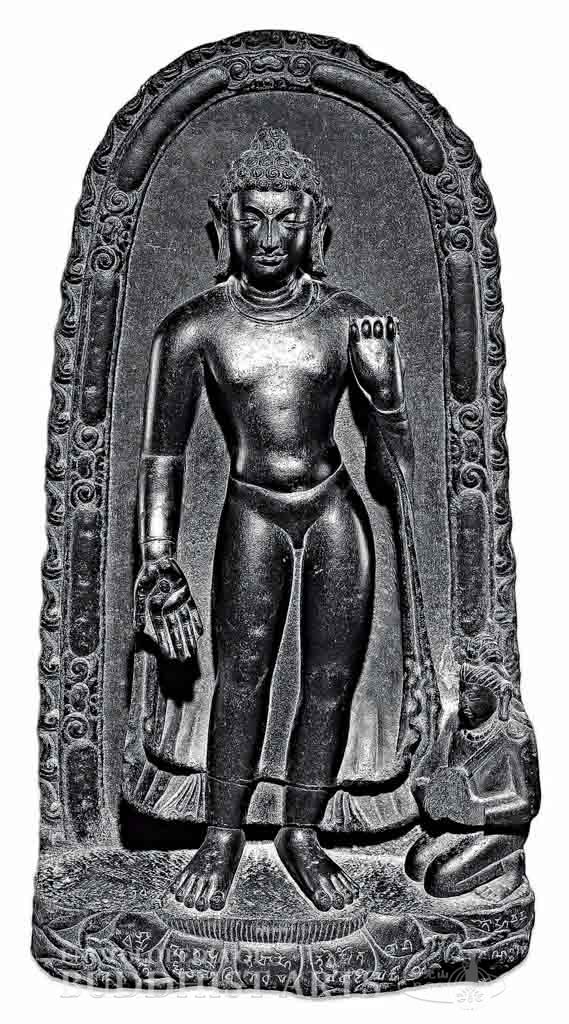
Sultanganj: Standing Buddha
Schist
Sultanganj: Standing Buddha
INDIA, Bihar, Sultanganj
This statue, created in the local style of Eastern India shows aspects of the Gupta influence. Signs of Buddhahood include a mounded usnisa, a mid-forehead urna, elongated earlobes, the three lines on the neck, webbing between long, slender fingers and toes, and a small Dharma wheel on the palm of the right hand. This hand is held outward in the varada (wish-granting) mudra, while the left hand curls back to arrange the fall of the monastic robe from the shoulder. The primary evidence of the robe’s presence is the rippling fall from the arms and its arc behind the calves. This is a noticeably Gupta feature, as is the stance with the body’s weight placed on the left foot, causing a displacement of the waist to the right.
A devotee kneels to the left of the lotus pedestal. Inscriptions can be found on the petals of the lotus pedestal. The composition is framed in a curving mandorla with a decorative inner band rimmed with flames.
For more details, go to the Encyclopedia of Buddhist Arts: Sculpture St-Z, page 1175.
Cite this article:
author = Hsingyun and Youheng and Lovelock, Yann and Chou, Yuan and Huntington, Susan and Edson, Gary and Neather, Robert,
booktitle = {Encyclopedia of Buddhist Arts: Sculpture St-Z},
pages = 1175,
title = {{Sultanganj: Standing Buddha}},
volume = 13,
year = {2016}}