
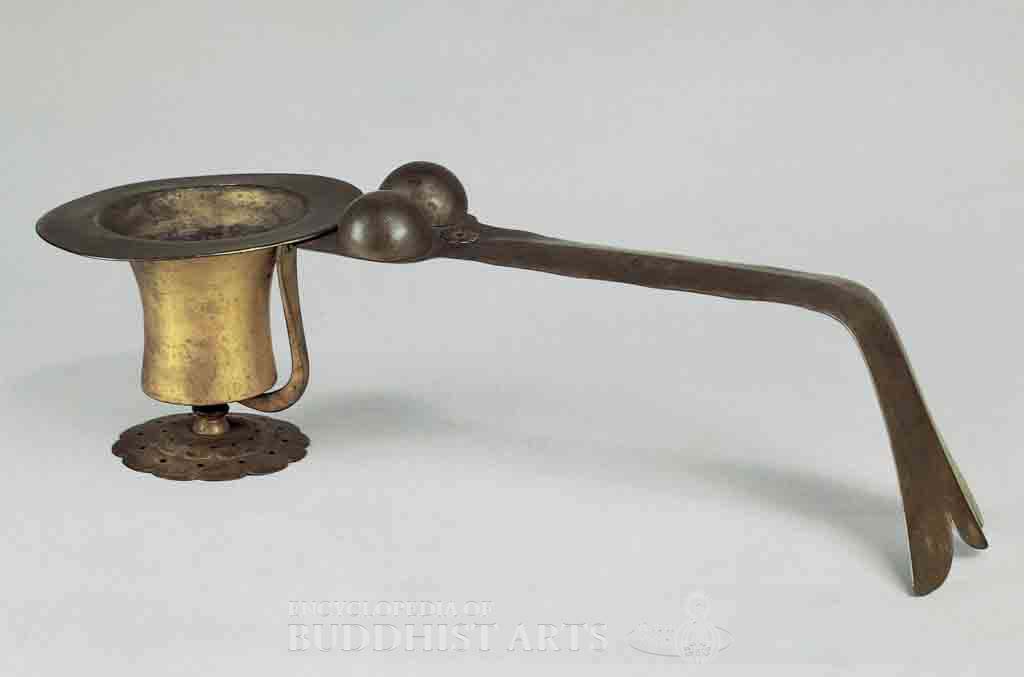
Horyuji Temple: Hand-Held Incense Burner
Gilt brass
Horyuji Temple: Hand-Held Incense Burner
JAPAN, Nara, Ikoma; Asuka period
Noted for its handle in the shape of a magpie’s tail, this hand-held incense burner was presented to the imperial court by Horyuji Temple. From the inscription found on the base and rim, it is known that Eji, a Korean monk from the Goguryeo dynasty (37 BCE–668 CE), once used this incense burner. Regarded as the oldest hand-held incense burner in Japan, it was listed as a National Treasure in 1964.
The incense burner is made of gilt brass and consists of a base, bowl, and long handle. The base has two layers of lotus petals, in between which is a narrow Sumeru-shape support. The cylindrical bowl flares slightly to form the mouth and wide rim, and the handle is attached to the bowl underneath the rim. Where the handle meets the rim, there are two hemispheres and a lotus design. At the opposite end, the handle bends downward to form the magpie’s tail.
For more details, go to the Encyclopedia of Buddhist Arts: Artifacts, page 128.
Cite this article:
author = Hsingyun and Youheng and Youji and Pokorski, Stefanie and Mankuang and Fan, Wen,
booktitle = {Encyclopedia of Buddhist Arts: Artifacts },
pages = 128,
title = {{Horyuji Temple: Hand-Held Incense Burner}},
volume = 18,
year = {2016}}