
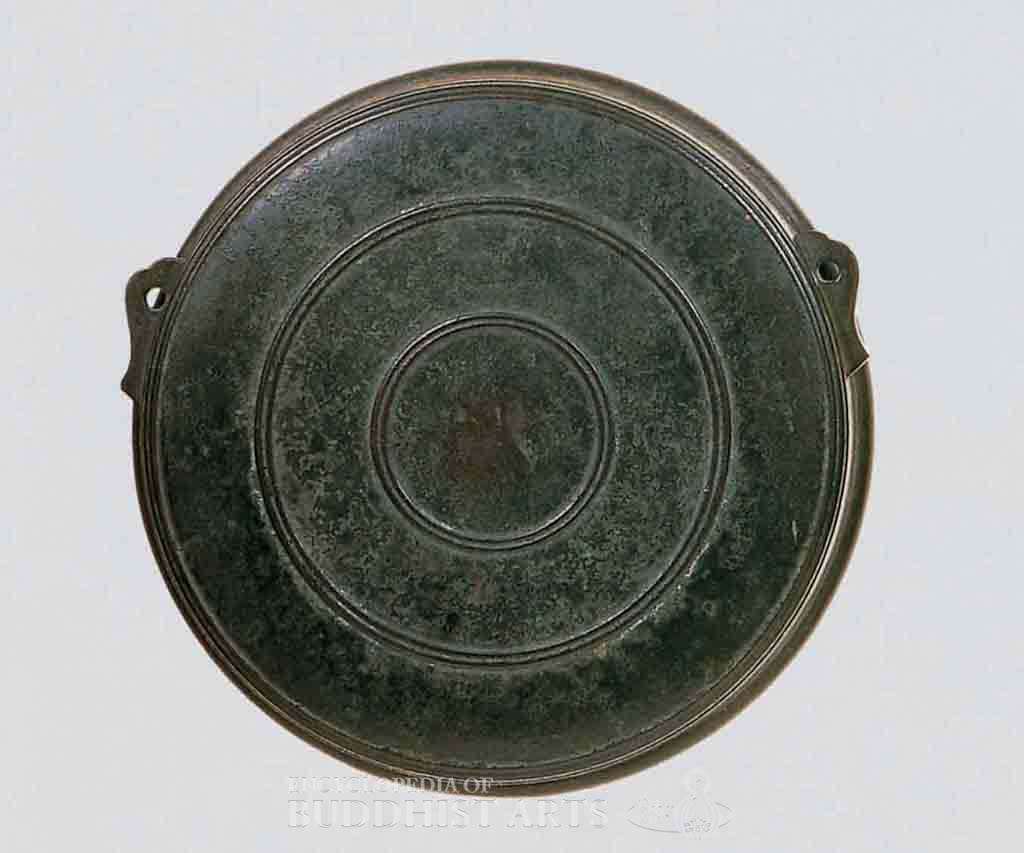
Todaiji Temple: Gong
Bronze
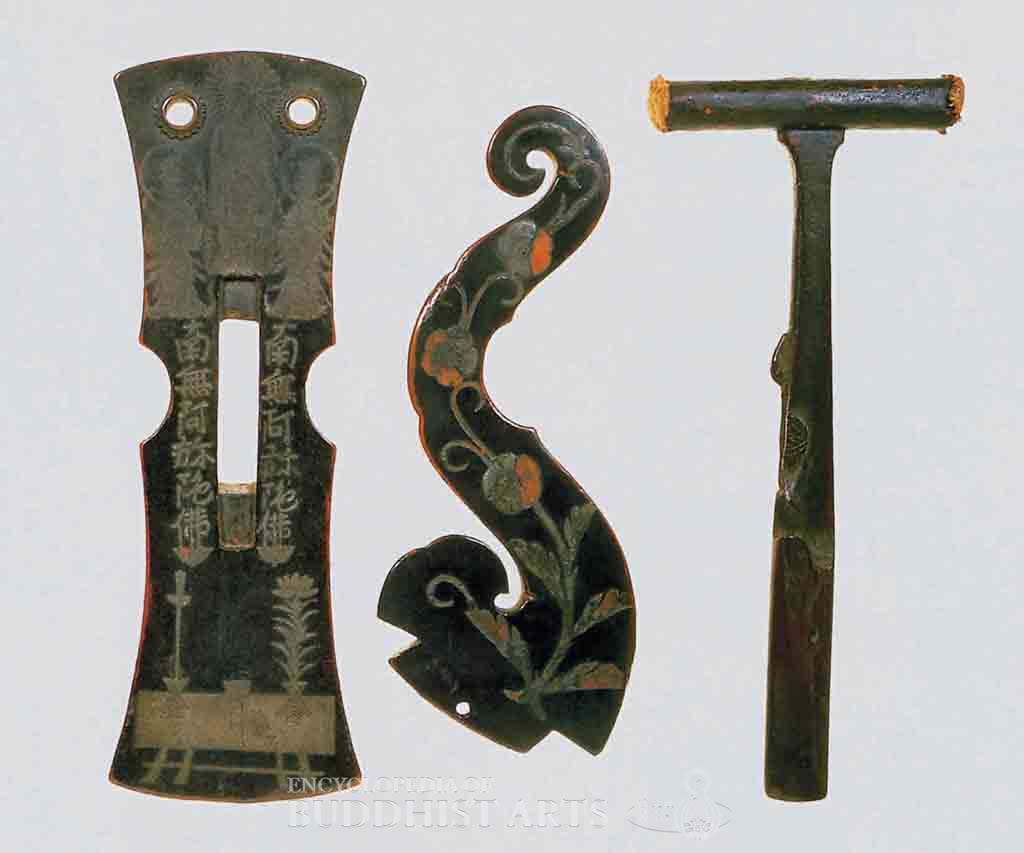
Todaiji Temple: Gong Accessories
Bronze and wood
Todaiji Temple: Gong
JAPAN, Nara; Kamakura period
According to an inscription on the underside of the gong, it was one of five used in Dharma functions conducted by Shunjobo Chogen, a monk from Todaiji Temple. It could also be hung around the neck and struck to mark the beat when chanting the Buddha’s name. It was listed as an Important Cultural Property in 1926.
The gong has three embossed concentric circles, and on the rim, there are two rings from which the gong was suspended. The plate, which was attached to the wall or beam, has a depiction of an Amitabha Buddha triad, an inscription with the name of Amitabha Buddha, and a table with an incense burner, vase, and candle holder. The bracket, from which the gong was suspended, has a floral decoration. The beater is made of camphor wood and is incised with a flower pattern.
For more details, go to the Encyclopedia of Buddhist Arts: Artifacts, page 338.
Cite this article:
author = Hsingyun and Youheng and Youji and Pokorski, Stefanie and Mankuang and Fan, Wen,
booktitle = {Encyclopedia of Buddhist Arts: Artifacts },
pages = 338,
title = {{Todaiji Temple: Gong}},
volume = 18,
year = {2016}}