
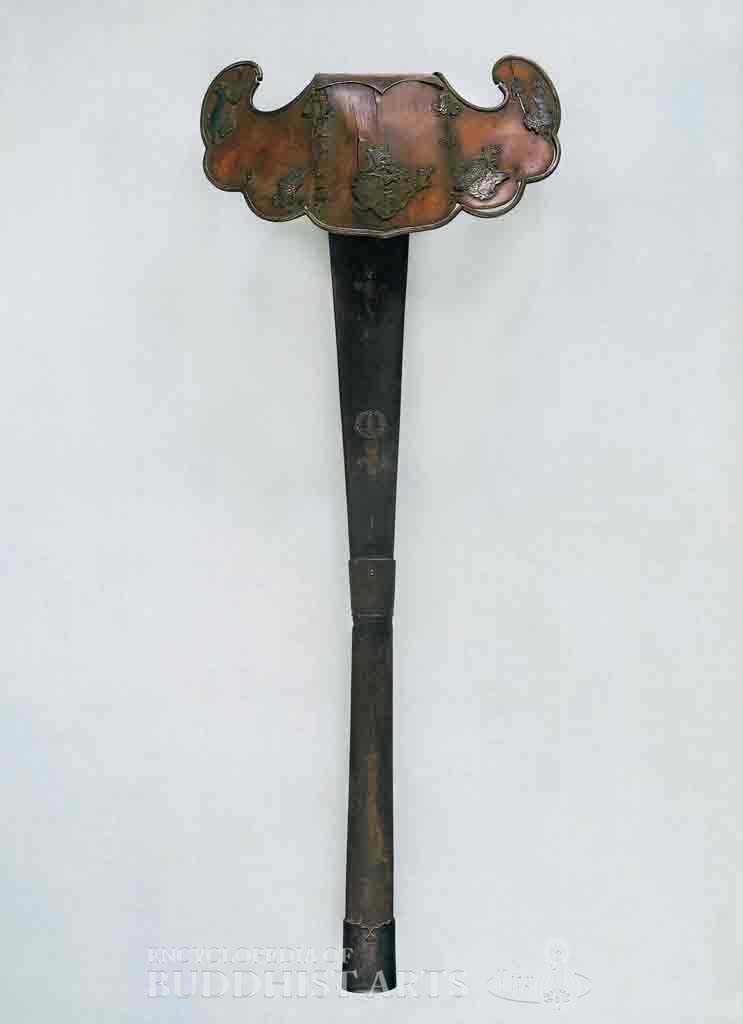
Todaiji Temple: Ruyi with Five Lions
Rhinoceros horn and silver
Todaiji Temple: Ruyi with Five Lions
JAPAN, Nara; Heian period
A ritual instrument used during Dharma functions, this ruyi is said to have been created by Emperor Uda (reigned 887–897) after he renounced. It was presented to the monks in Todaiji Temple and was listed as an Important Cultural Property in 1902.
The handle of the ruyi is made from rhinoceros horn and measures 88.8 cm long. The head is in the shape of a bat and is 27.9 cm wide. Five silver lions and cloud patterns decorate the head, which is surrounded by a silver border. There are five three-prong vajras on the front and back of the handle. The lions represent Mahayana Buddhism and the three-prong vajras refer to Vajrayana Buddhism.
For more details, go to the Encyclopedia of Buddhist Arts: Artifacts, page 339.
Cite this article:
Hsingyun, et al. "Todaiji Temple: Ruyi with Five Lions." Encyclopedia of Buddhist Arts: Artifacts , vol. 18, 2016, pp. 339.
Hsingyun, Youheng, Youji, Stefanie Pokorski, Mankuang, and Wen Fan. 2016. "Todaiji Temple: Ruyi with Five Lions" In Encyclopedia of Buddhist Arts: Artifacts , 18:339.
Hsingyun, Youheng, Youji, Pokorski, S., Mankuang, & Fan, W.. (2016). Todaiji Temple: Ruyi with Five Lions. In Encyclopedia of Buddhist Arts: Artifacts (Vol. 18, pp. 339).
@misc{Hsingyun2016,
author = Hsingyun and Youheng and Youji and Pokorski, Stefanie and Mankuang and Fan, Wen,
booktitle = {Encyclopedia of Buddhist Arts: Artifacts },
pages = 339,
title = {{Todaiji Temple: Ruyi with Five Lions}},
volume = 18,
year = {2016}}
author = Hsingyun and Youheng and Youji and Pokorski, Stefanie and Mankuang and Fan, Wen,
booktitle = {Encyclopedia of Buddhist Arts: Artifacts },
pages = 339,
title = {{Todaiji Temple: Ruyi with Five Lions}},
volume = 18,
year = {2016}}