
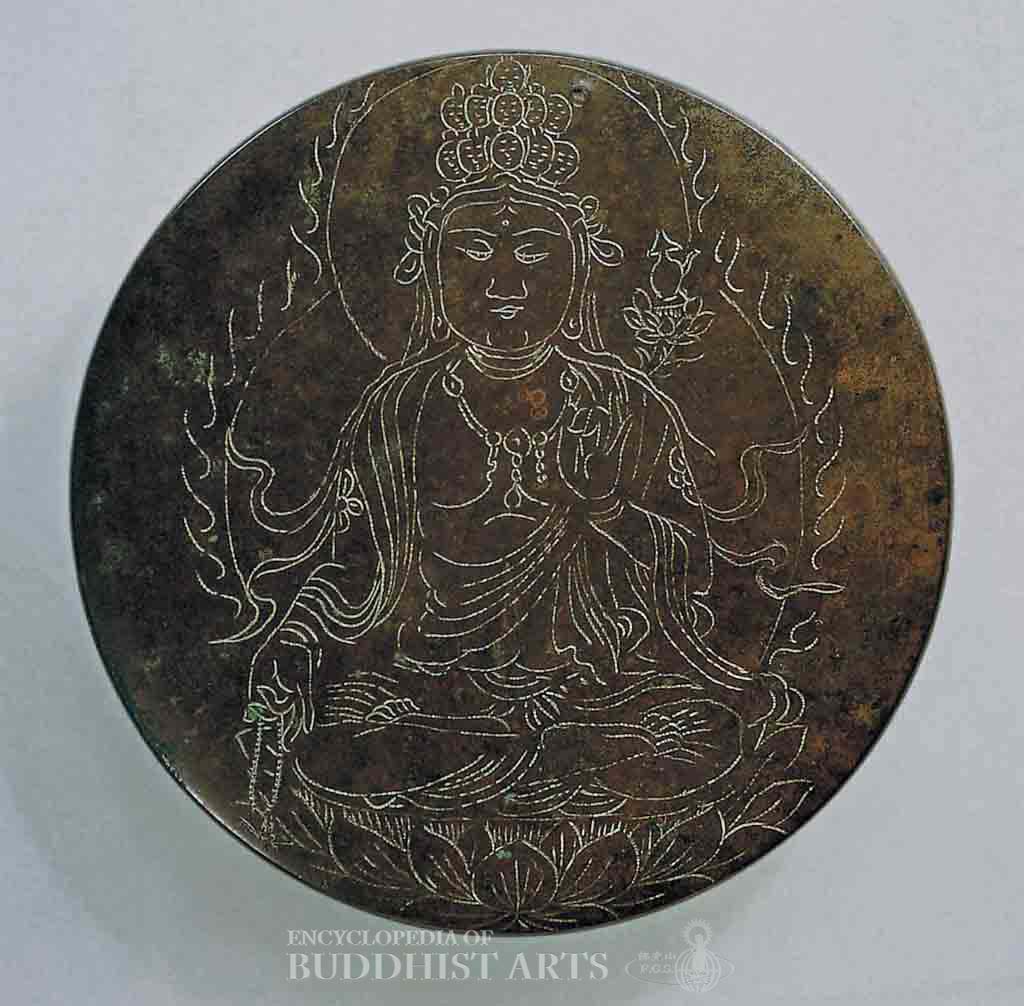
Mirror with Eleven-Headed Avalokitesvara (front)
Bronze
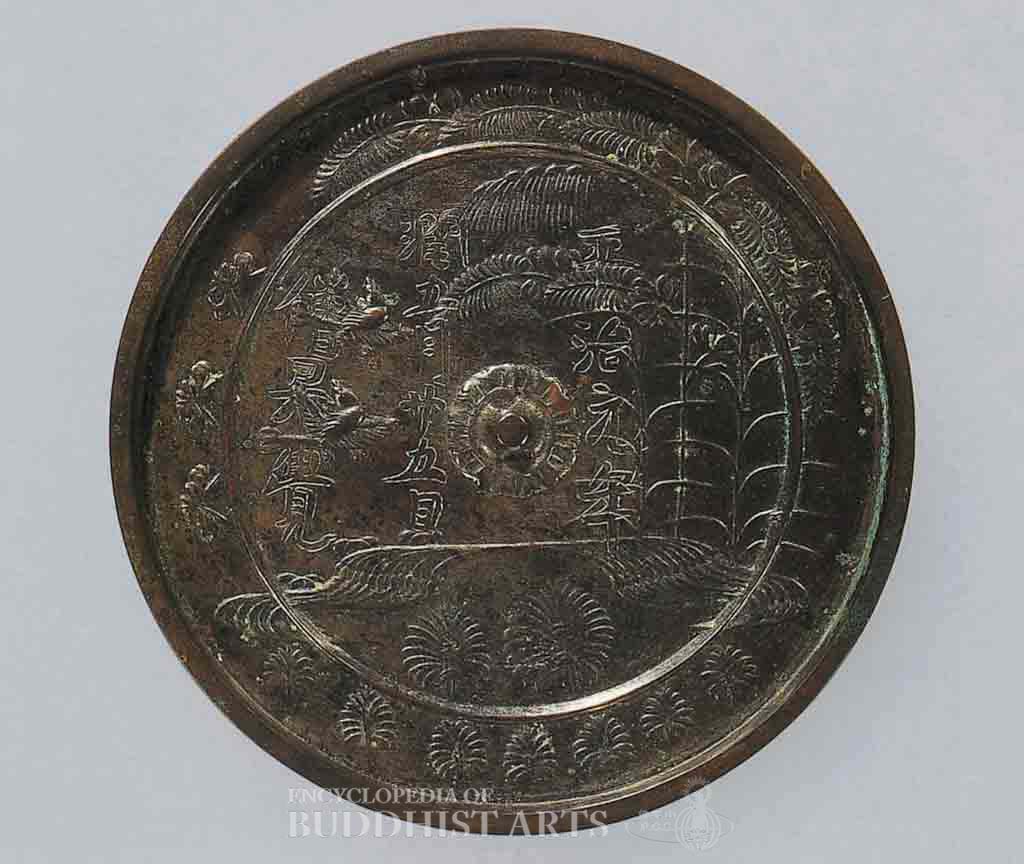
Mirror with Eleven-Headed Avalokitesvara (back)
Mirror with Eleven-Headed Avalokitesvara
JAPAN; Heian period
This engraved mirror was created in 1159, and was listed as an Important Cultural Property in 1993.
The principal head of Avalokitesvara Bodhisattva is surmounted by eleven heads arranged in three rows. Ribbons hang down from the headdress to the shoulders, and the round face features eyes cast downward, a large nose, narrow mouth, and long earlobes. The Bodhisattva is seated in full lotus position upon a lotus throne. The left hand performs a mudra and holds a lotus surmounted by a vase, while the right hand holds prayer beads and rests on the knee. The nimbus and mandorla are edged with a flame pattern.
The back of the mirror has a central boss and is decorated with various motifs, such as flowing water, ferns, palm leaves, butterflies, and birds. The inscription gives reference to a monk Kokaku and to the date.
For more details, go to the Encyclopedia of Buddhist Arts: Artifacts, page 195.
Cite this article:
author = Hsingyun and Youheng and Youji and Pokorski, Stefanie and Mankuang and Fan, Wen,
booktitle = {Encyclopedia of Buddhist Arts: Artifacts },
pages = 195,
title = {{Mirror with Eleven-Headed Avalokitesvara}},
volume = 18,
year = {2016}}