
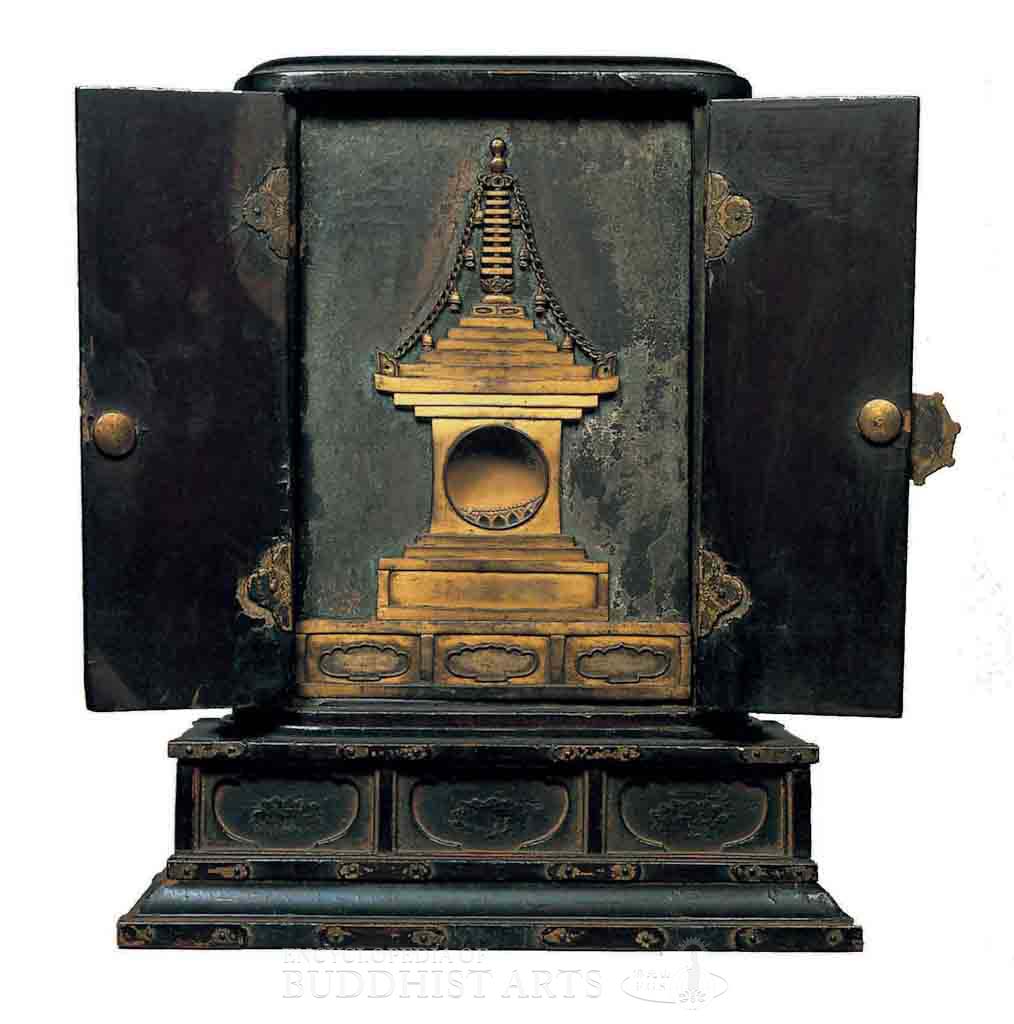
Reliquary Cabinet
Wood
Reliquary Cabinet
JAPAN; Kamakura period
This 13th century wooden cabinet was used to enshrine relics and was listed as an Important Cultural Property in 1999. The black lacquered cabinet has a base and body which are detachable. The upper part of the base has three panels in which there are cloud-like indentations with indistinct floral patterns. The two doors open to reveal the gilt copper alloy relief of a pagoda with a base, body, and spire. The base is in three layers: the lowest layer is in imitation of the base of the cabinet, with three panels with cloud-like plain indentations, followed by a plain middle layer, and an upper layer consisting of inverse corbeling. The body of the pagoda is square with a circular opening in which the relics are kept. Above, there is corbeling followed by the base of the spire which consists of reverse corbeling. The square harmika is followed by an inverted bowl, flower bowl, nine stacked rings, and a jewel. The base of the finial is connected to the base of the spire by two chains from which hang wind chimes.
The rear of the cabinet is colored and gold-leafed with a mandala and image of Sakyamuni Buddha. Inside the cabinet, there is an eight-fascicle set of the Lotus Sutra.
For more details, go to the Encyclopedia of Buddhist Arts: Artifacts, page 276.
Cite this article:
author = Hsingyun and Youheng and Youji and Pokorski, Stefanie and Mankuang and Fan, Wen,
booktitle = {Encyclopedia of Buddhist Arts: Artifacts },
pages = 276,
title = {{Reliquary Cabinet}},
volume = 18,
year = {2016}}