
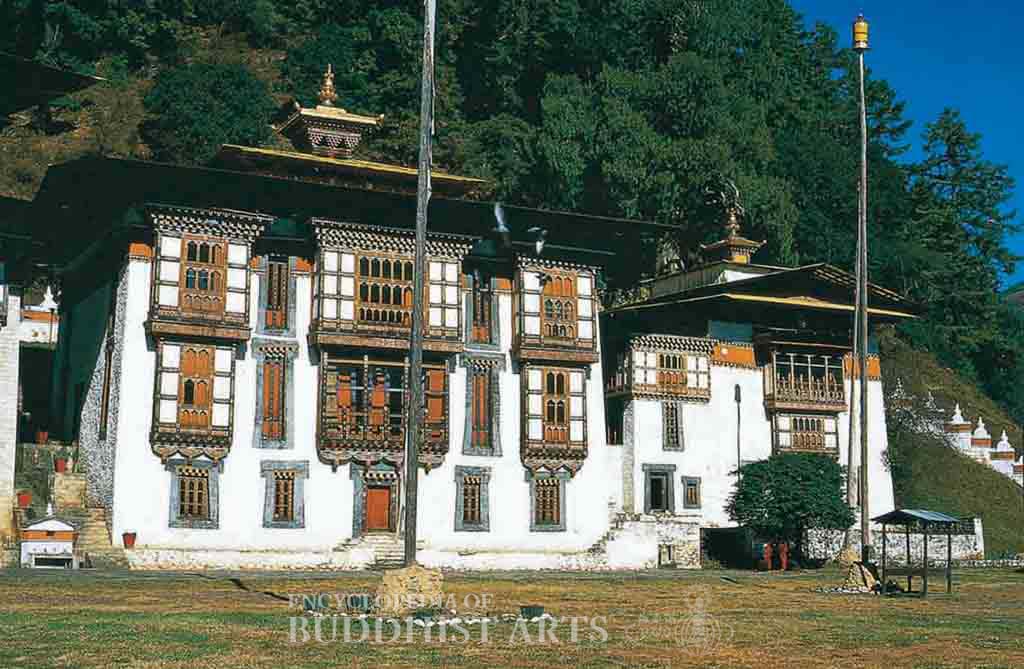
Kurje Monastery
Kurje Monastery
BHUTAN, Bumthang
Kurje means Body Imprint. It is said that in the 8th century Padmasambhava arrived there to subdue evil spirits. After meditating in a cave, the imprint of his body was left on the wall. A temple was built at this site in 1652 and it is considered a holy place.
The main buildings consist of three shrines built in a line. They are brick, stone, and wooden buildings with pyramidal roofs. The window frames are wooden and are colorfully decorated in contrast to the white walls. The shrine on the right is the oldest building and was the original place where Padmasambhava meditated. The central shrine was constructed by the first king, Gongsar Ugyen Wangchuck (reigned 1907–1926). The statue of Padmasambhava, which is the largest of its kind in the whole Himalayan region, is enshrined there. The shrine on the left was built with the sponsorship of Queen Ashi Kesang Choden Wangchuck. A statue of the wrathful Padmasambhava is enshrined here.
For more details, go to the Encyclopedia of Buddhist Arts: Architecture G-L, page 636.
Cite this article:
author = Hsingyun and Youheng and Johnson, Peter and Mankuang and Lancaster, Lewis,
booktitle = {Encyclopedia of Buddhist Arts: Architecture G-L},
pages = 636,
title = {{Kurje Monastery}},
volume = 2,
year = {2016}}