
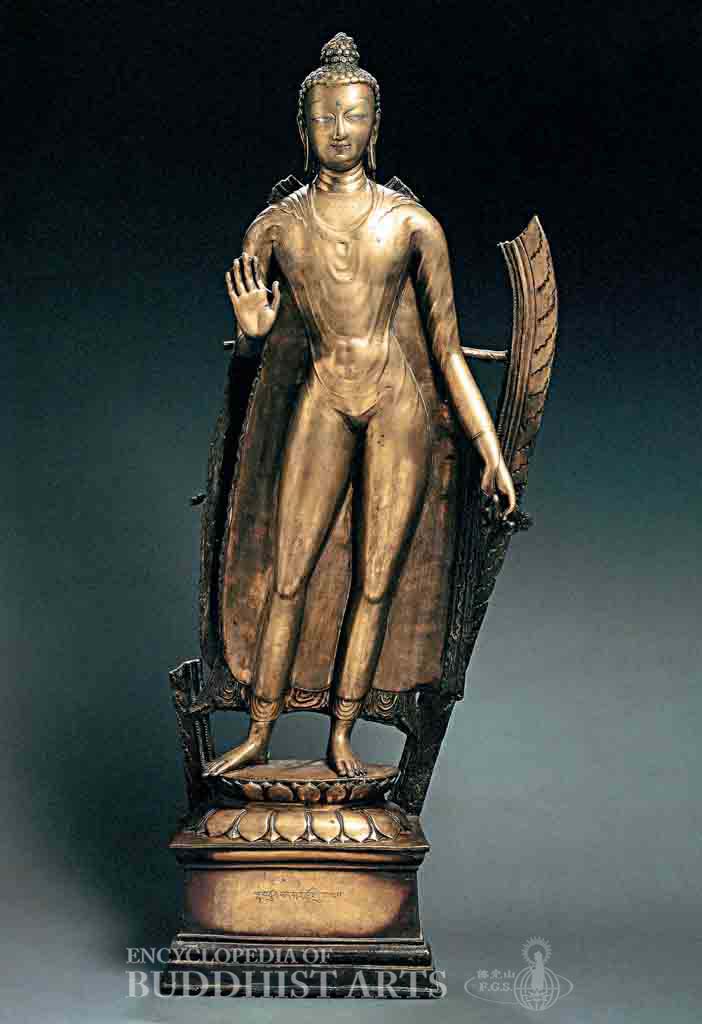
Standing Buddha
Brass inlaid with silver and copper
Standing Buddha
INDIA
This work is one of the largest metal statues in Kashmiri style. A line of Tibetan text on the base may indicate either the statue was created in Kashmir and taken to Tibet, or was made in Tibet by Kashmiri artists.
The Buddha stands in an exaggeratedly tribhanga posture with right leg extended, displacing the waist to one side. The right hand is in abhaya (fearlessness) mudra and the left arm stretched outward, creating a counter-balancing movement. The raised right hand displays webbing between the fingers. A monastic robe covers both shoulders and clings closely to the muscular body, displaying the style reminiscent of the Gupta period (circa 320–550). The robe’s presence is primarily implied by the deep fall of the material over the arms, causing it to spread on either side. The inner surface is indicated by an intricately ruffled pattern.
The figure stands on a double lotus pedestal mounted on a stepped rectangular stand. Enough remains of the openwork mandorla the stand once supported to distinguish a beaded inner rim and a surround of stylized flames.
For more details, go to the Encyclopedia of Buddhist Arts: Sculpture St-Z, page 1139.
Cite this article:
author = Hsingyun and Youheng and Lovelock, Yann and Chou, Yuan and Huntington, Susan and Edson, Gary and Neather, Robert,
booktitle = {Encyclopedia of Buddhist Arts: Sculpture St-Z},
pages = 1139,
title = {{Standing Buddha}},
volume = 13,
year = {2016}}