
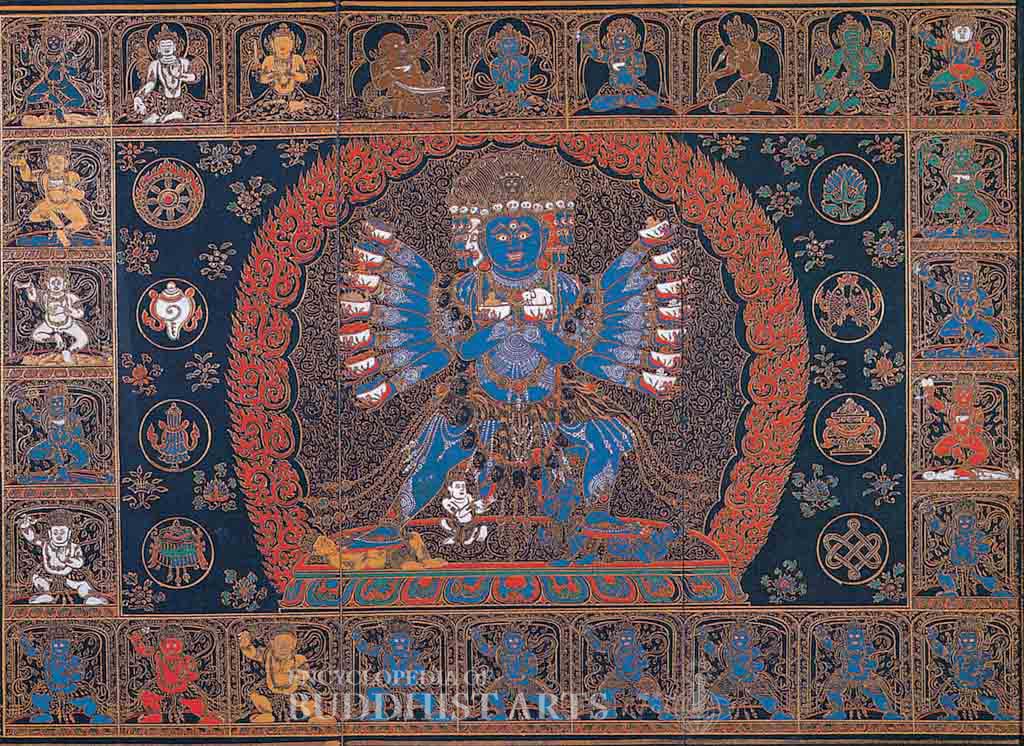
Frontispiece of the Hevajra Tantra
Gold and color on indigo paper
Frontispiece of the Hevajra Tantra
CHINA; Ming dynasty
This is the frontispiece of a Ming dynasty version of the Hevajra Tantra that was transcribed in gold and kept in the Imperial Palace. The image occupies a three-page fold, with Hevajra standing in the center. He is depicted standing in the warrior stance with eight heads and sixteen arms. Each head has three eyes, snarling lips, and golden hair that stands straight up. Hevajra wears a crown of skulls, a garland of 50 human heads, and golden jewelry. His blue body is painted with intricate white designs. He stands upon two prone figures, and holds skull cups containing various beings and deities.Two small figures kneel between Hevajra’s legs. An exquisite patterned mandorla surrounds the central figure. The surrounding blue background is decorated with flowers and the eight auspicious symbols: a wheel, a conch shell, a banner, a parasol, a lotus, twin fish, a vase, and an auspicious knot. The border of the image is divided into 26 squares, each with a figure inside. Some of the figures shown include Vidyarajni, Manjusri Bodhisattva, White Tara, Green Tara, Acala, and Niadanda.
For more details, go to the Encyclopedia of Buddhist Arts: Painting A-H, page 263.
Cite this article:
author = Hsingyun and Youheng and Youlu and Wilson, Graham and Manho and Mankuang and Huntington, Susan,
booktitle = {Encyclopedia of Buddhist Arts: Painting A-H},
pages = 263,
title = {{Frontispiece of the Hevajra Tantra}},
volume = 14,
year = {2016}}