
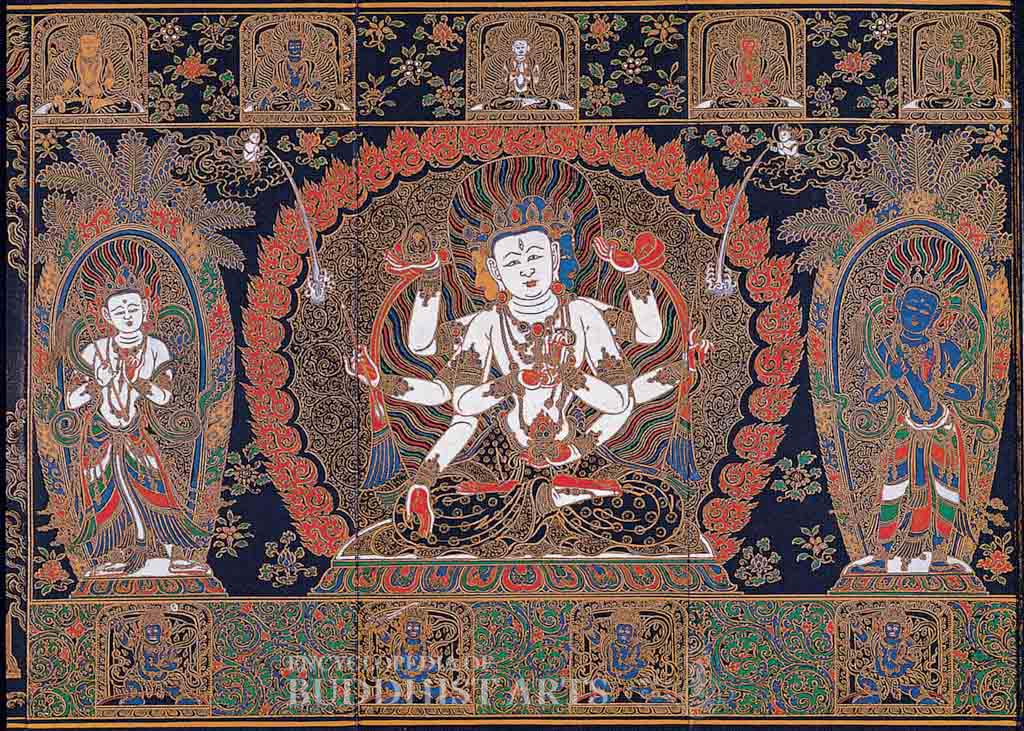
Frontispiece of the Usnisavijaya Tantra
Gold and color on indigo paper
Frontispiece of the Usnisavijaya Tantra
CHINA; Ming dynasty
This frontispiece belongs to a Ming dynasty version of the Usnisavijaya Tantra. It occupies three pages, with a seated Usnisavijaya in the center, flanked by Avalokitesvara and Vajrapani.
Usnisavijaya has three heads and eight arms, and is seated in full lotus position on a Sumeru throne. The main head is colored in white, while the other two heads are yellow and blue. Both the nimbus and aureole are decorated with thin curving lines in alternating colors. Numerous golden ornaments and pieces of jewelry adorn Usnisavijaya’s arms and chest. The hands hold a pestle, a noose, a Buddha image, an arrow, a bow, and a vase, and form the varada (wish-granting) and abhaya (fearlessness) mudras. Above Usnisavijaya, two heavenly beings pour streams of water down into the gold patterned mandorla, which is surrounded by curving flame designs.
The two attendant Bodhisattvas stand in the tribhanga posture and hold whisks. Avalokitesvara, shown on the left, has white skin, while Vajrapani is blue in color. Both figures wear golden headdresses and jewelry, and have colorful patterned nimbuses and mandorlas topped with leaves.
The Five Dhyani Buddhas, with Vairocana Buddha in the center, are painted along the top of the image. At the bottom there are images of the Four Wisdom Kings: Acala of the Northeast, Takkiraja of the Southeast, Niadanda of the Southwest, and Vajramaharaja of the Northwest.
For more details, go to the Encyclopedia of Buddhist Arts: Painting A-H, page 269.
Cite this article:
author = Hsingyun and Youheng and Youlu and Wilson, Graham and Manho and Mankuang and Huntington, Susan,
booktitle = {Encyclopedia of Buddhist Arts: Painting A-H},
pages = 269,
title = {{Frontispiece of the Usnisavijaya Tantra}},
volume = 14,
year = {2016}}