
Arhat
Ink and color on silk
Arhat
CHINA; Qing dynasty
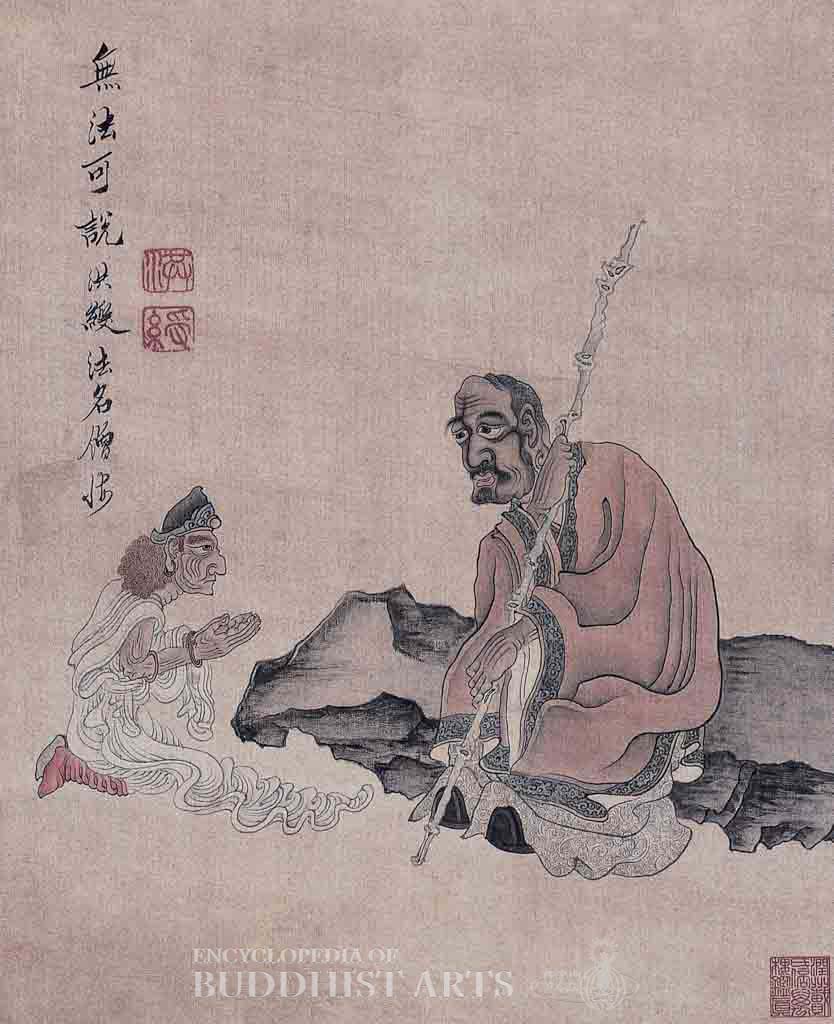
The Diamond Sutra states, “as to speaking truth, no truth can be spoken.” An inscription on this painting echoes, “No truth can be spoken,” followed by the signature of the artist, Hongshou, Dharma name Senghui. Originally named Chen, he received the name Senghui after becoming a monk in 1646, indicating that this picture was painted after he was ordained.
The Arhat is portrayed sitting on a rock, leaning on a staff. On the left, an emaciated figure with a focused and sincere expression kneels before the Arhat and appears to ask for teachings. The Arhat’s compassionate gaze suggests both a will to teach and a knowledge that “no truth can be spoken.”
The dense, dark lines on the face of Arhat give him a rough appearance, a sharp contrast to the grace and fluidity of Chen’s earlier paintings. Images of Arhats began to be painted during the Five Dynasties (907–960), notably by the Chan Master Guanxiu. His paintings of the Sixteen Arhats were reproduced and widely distributed in the form of stone carvings and imprints during the Ming dynasty (1368–1644). This picture appears to have been based on one of Guanxui’s artworks.
For more details, go to the Encyclopedia of Buddhist Arts: Painting A-H, page 54.
Cite this article:
author = Hsingyun and Youheng and Youlu and Wilson, Graham and Manho and Mankuang and Huntington, Susan,
booktitle = {Encyclopedia of Buddhist Arts: Painting A-H},
pages = 54,
title = {{Arhat}},
volume = 14,
year = {2016}}