
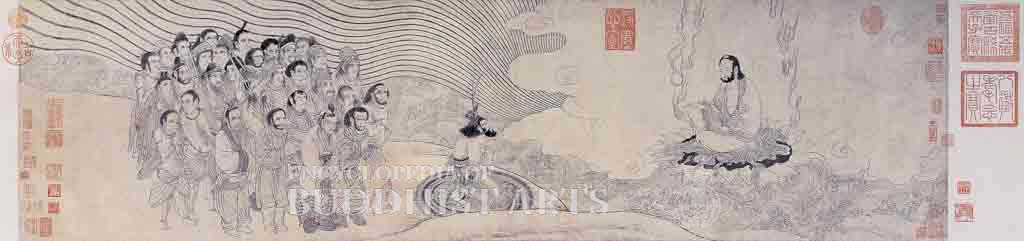
King Paying Respect to the Buddha (detail)
Ink on paper

King Paying Respect to the Buddha
CHINA; Yuan dynasty
This painted scroll begins with four characters written by Tang Yu that translate as “King Paying Respect to the Buddha.” At the end of the scroll, there are inscriptions by Miaosheng, Li Jian, Yu Ze, and Yi Wei of the Yuan dynasty (1271–1368). The scroll was owned by Wu Kuan of the Ming dynasty (1368–1644), Gao Shiqi of the early Qing dynasty (1644–1911), and the Qing Imperial Cabinet.
The composition can be divided into two sections. On the right, the Buddha sits on a lotus throne above a stormy sea. He has a beard, long ears, and a small usnisa. The Buddha is surrounded by a mandorla outlined with flame patterns. Clouds are painted behind the mandorla. Curving black lines radiate out from the clouds and cover the upper left section of the scroll. On the shore to the left of the Buddha, a foreign king joins his palms and kneels upon a rug. The king has a thick beard and wears a headdress decorated with tall feathers. On the far left, there is a group of thirty figures standing close together. Each figure has unique facial features. Some have thick, dark hair, while others are bald or have beards.
Exquisitely drawn curving lines are used to depict the robe of the Buddha and the waves below the lotus throne. These detailed lines are emphasized by the vast empty space surrounding the Buddha. The facial features and beards of the figures are portrayed with delicate shading.
For more details, go to the Encyclopedia of Buddhist Arts: Painting I-O, page 436.
Cite this article:
author = Hsingyun and Youheng and Youlu and Wilson, Graham and Manho and Mankuang and Huntington, Susan,
booktitle = {Encyclopedia of Buddhist Arts: Painting I-O},
pages = 436,
title = {{King Paying Respect to the Buddha}},
volume = 15,
year = {2016}}