
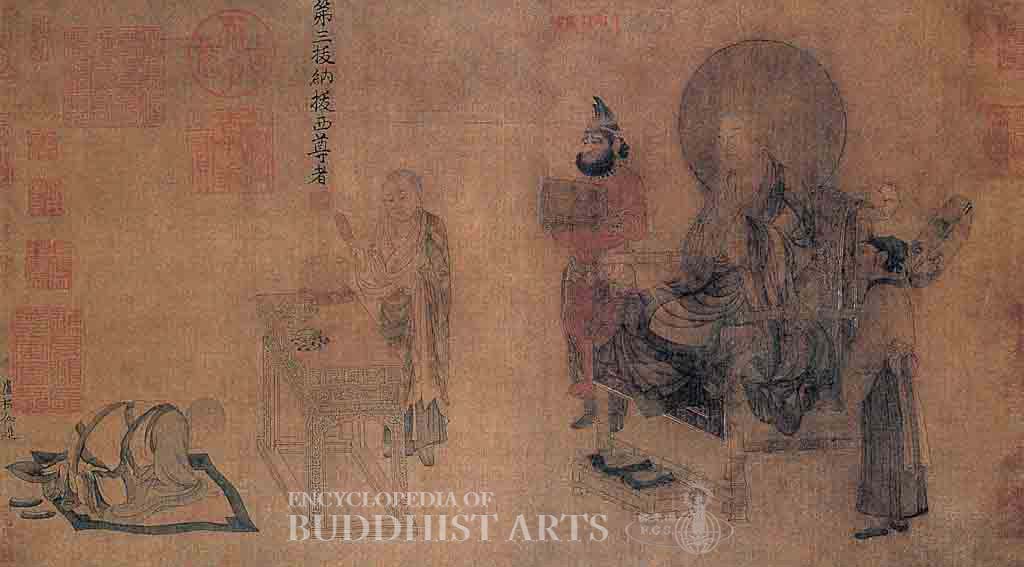
Eighteen Arhats - Vanavasa
Ink and color on silk
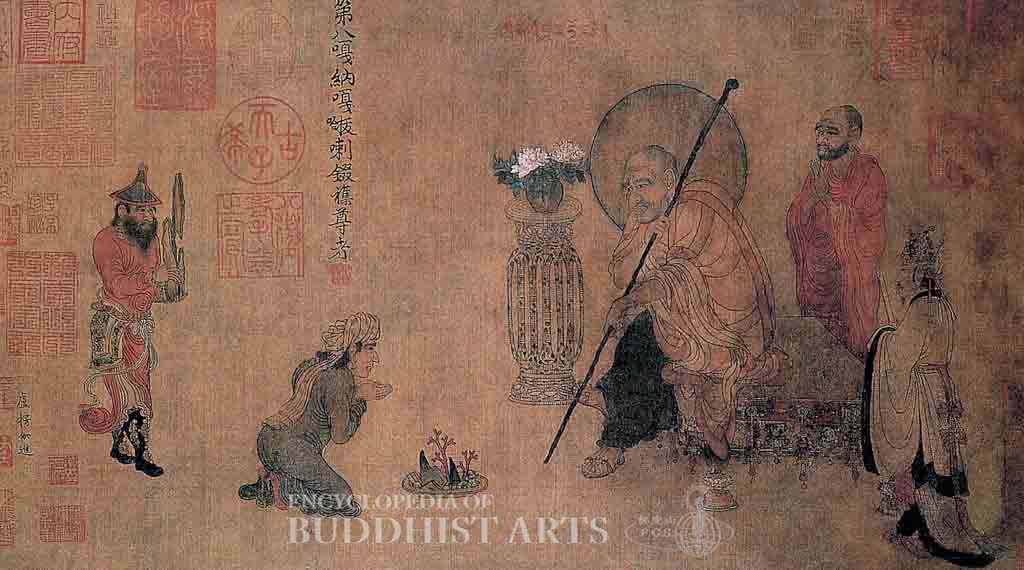
Eighteen Arhats - Kanakabharadraja
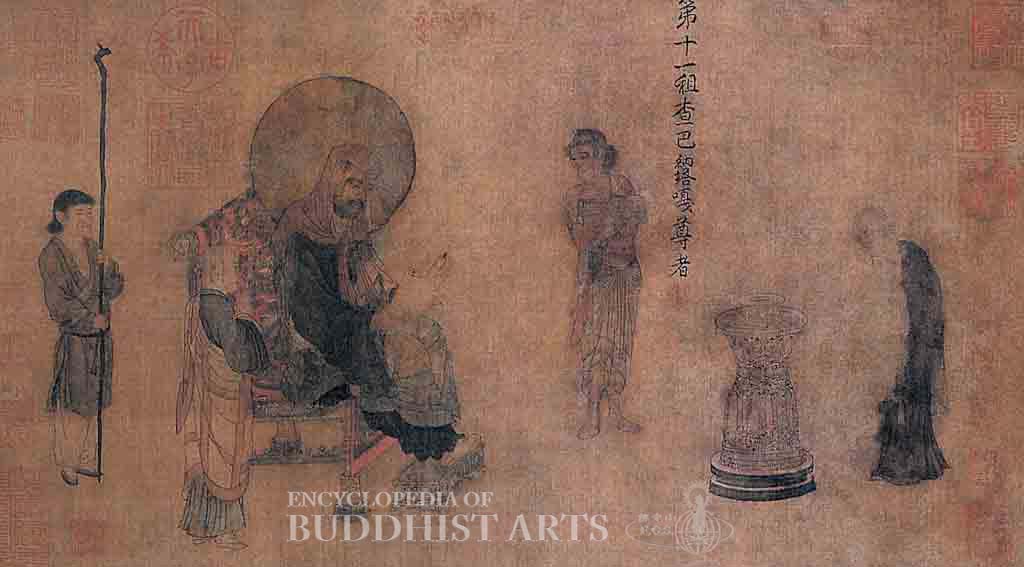
Eighteen Arhats - Cudapanthaka
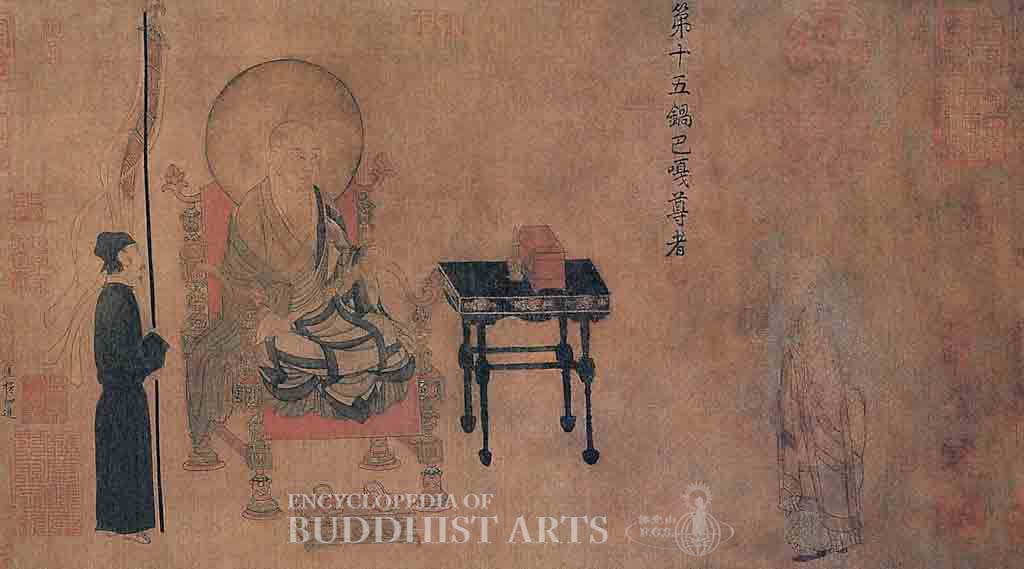
Eighteen Arhats - Gobaka
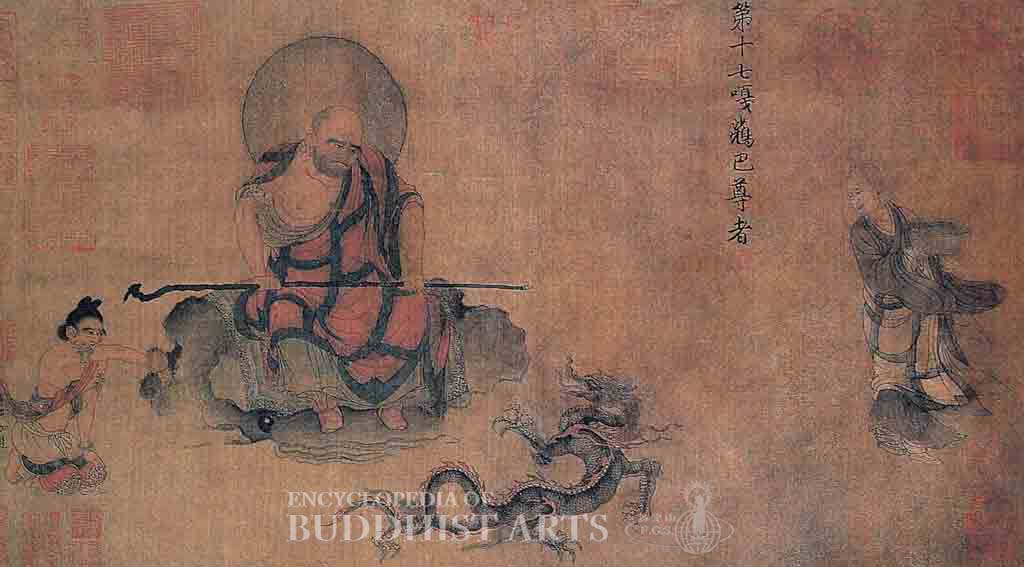
Eighteen Arhats - Dragon-Subduing Arhat
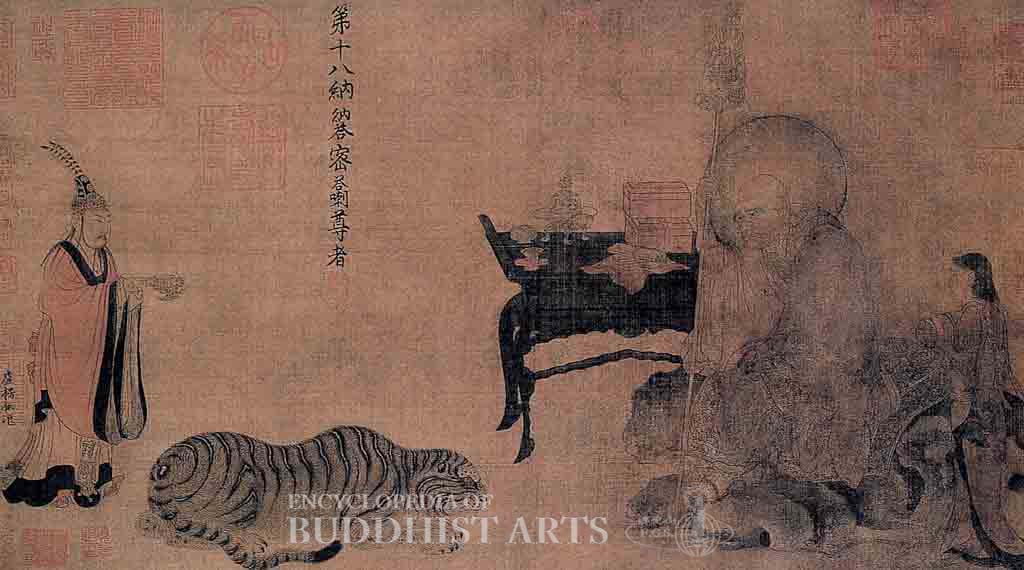
Eighteen Arhats - Tiger-Taming Arhat
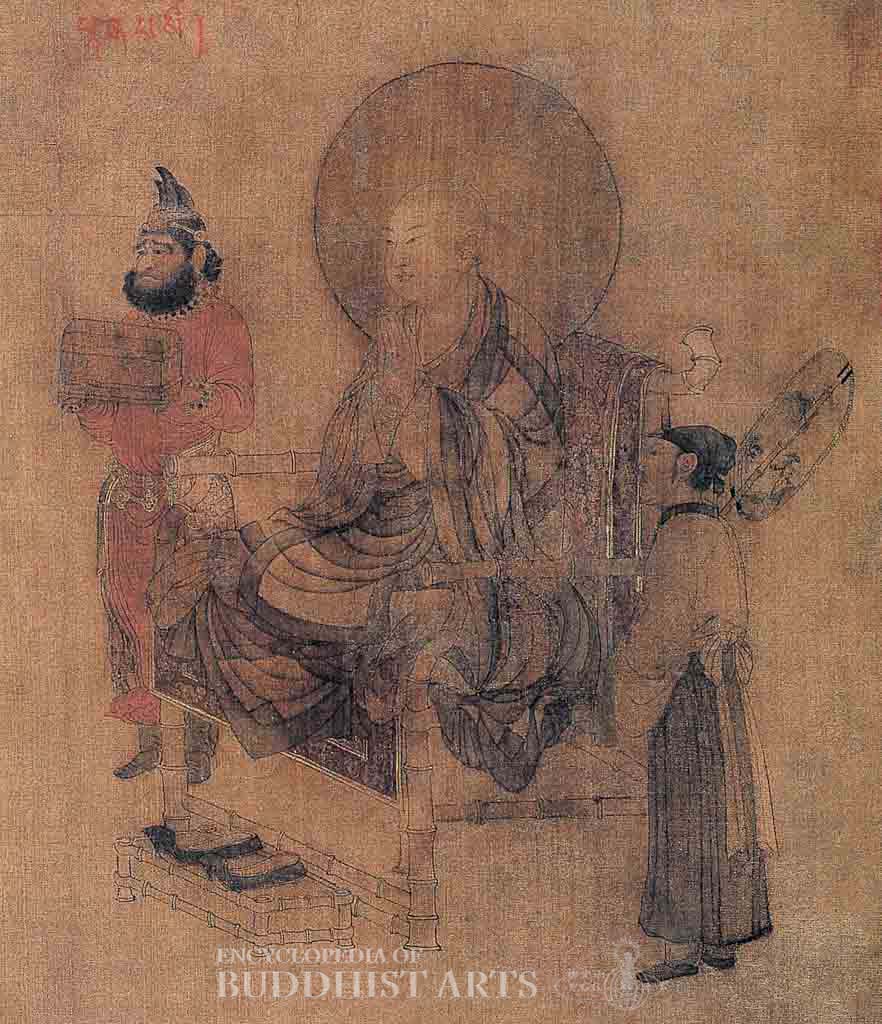
Eighteen Arhats - Vanavasa (detail)
Eighteen Arhats
CHINA; Northern Song dynasty
These six illustrations were originally part of a set of pictures depicting the Eighteen Arhats. The other 12 images have been lost. During the Tang dynasty (618–907), the Sixteen Arhats were painted according to descriptions in the Records of Nandimitra’s Discourse on Abiding Dharma. Beginning in the Northern Song dynasty (960 –1127), the Tiger-Taming and Dragon-Subduing Arhats were sometimes added to the group. The presence of these two figures suggest that the illustrations date from this time. Thus, the signature of the Tang dynasty painter Lu Lenqqie on the artworks is thought to be fake.
Each page is 30 cm high and 53 cm wide. They are each marked with several inscriptions and seals. The name of each Arhat is written in Tibetan at the top of each picture. There is a Northern Song dynasty “Xuanhe” (1119–1125) seal, a Southern Song dynasty “Shaoxing” (1131–1162) seal, and a Yuan dynasty (1271–1368) seal reading “Collection of the Imperial Sister” stamped at the top of the images. Emperor Qianlong (reigned 1736–1795) wrote the name of each Arhat and inscribed his praises in black ink.
The six Arhats are seated on large chairs, rocks, or angular thrones. They are accompanied by disciples, attendants, and devotees who join their palms in reverence, present offerings, or stand carrying banners, fans, or staffs. The Dragon-Subduing Arhat is depicted frowning, with wide eyes and pursed lips. He holds a staff with both hands and subdues the fearsome dragon below him. The Tiger-Taming Arhat has a thoughtful expression and is seated on a rock. His right hand holds a monk’s staff, his body leans slightly forward, and he gazes intently at a crouching tiger.
The illustrations are meticulously drawn with fine, careful lines. It appears that much thought was put into the placement of the tables, chairs, vases and objects of offering. The figures are portrayed in traditional Northern Song style, appearing both elegant and realistic.
For more details, go to the Encyclopedia of Buddhist Arts: Painting A-H, page 212.
Cite this article:
author = Hsingyun and Youheng and Youlu and Wilson, Graham and Manho and Mankuang and Huntington, Susan,
booktitle = {Encyclopedia of Buddhist Arts: Painting A-H},
pages = 212,
title = {{Eighteen Arhats}},
volume = 14,
year = {2016}}