
Avalokitesvara Bodhisattva
Ink on paper
Avalokitesvara Bodhisattva
CHINA; Qing dynasty
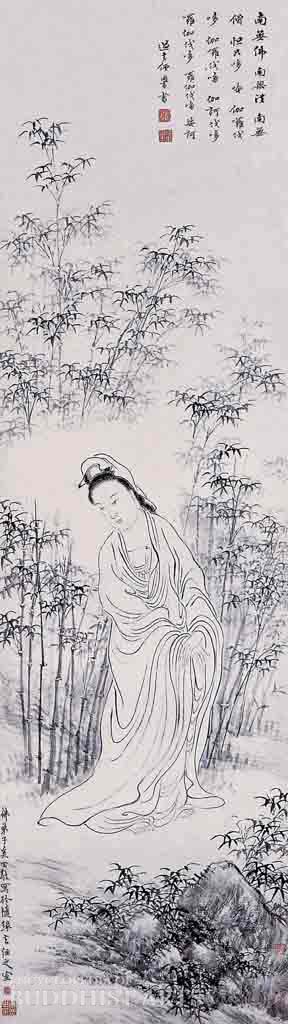
Avalokitesvara Bodhisattva has a rounded, pleasant-looking face. The head is slightly turned and lowered, the shoulders are rounded, and the hands are crossed in front of the stomach. A shawl is worn over the topknot, and the long white robe hangs down to the ground, but leaves the toes exposed. The face is delicately outlined with faint lines, while the clothing is articulated with flowing strokes and broad, sweeping curves. This style is a further development of the “floating silk-threaded lines” style pioneered by the Eastern Jin dynasty (317–420) painter Gu Kaizhi.
Behind the Bodhisattva, there is a bamboo forest. The tall grove is painted in various shades of gray amidst blank spaces representing rising mist, giving the picture a dreamlike atmosphere. The rock in the bottom right corner is painted with the textural strokes known as “bands dragged in mud,” an effect created by a combination of wet and dry brushwork. The result is a sturdy form with a moist look. The inscription and the two seal imprints on the lower left are by the artist, Xi Gang.
For more details, go to the Encyclopedia of Buddhist Arts: Painting A-H, page 74.
Cite this article:
author = Hsingyun and Youheng and Youlu and Wilson, Graham and Manho and Mankuang and Huntington, Susan,
booktitle = {Encyclopedia of Buddhist Arts: Painting A-H},
pages = 74,
title = {{Avalokitesvara Bodhisattva}},
volume = 14,
year = {2016}}