
Budai
Ink and color on silk
Budai
CHINA; Southern Song dynasty
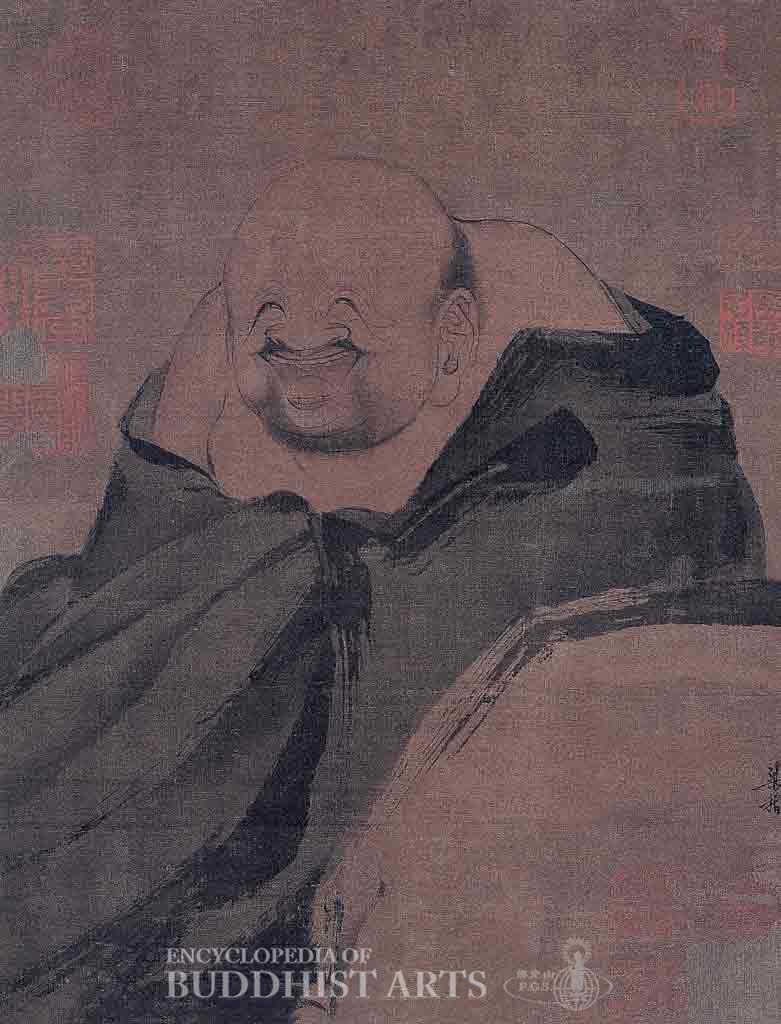
This painting, attributed to Liang Kai, is one of the earliest depictions of the legendary monk Budai, who is said to have lived during the Fve Dynasties (907–960). Also known as Qici, he was a jolly, contented wanderer who was often seen carrying a cloth sack (“budai” in Chinese). Before he passed away, Budai composed a verse saying, “Maitreya, real Maitreya, hundreds of billions of identities, time to time appearing before people, yet people know not.” It is thought that Budai himself was a manifestation of Maitreya.
Budai’s shoulders are hunched and his hands are concealed within his robe. He has small, drooping eyes, a large nose, and a mouth opened wide with laughter. The empty space in the lower right corner implies the large cloth sack. The face and shoulders are painted with delicate brushstrokes. Large areas of the monastic robe are washed to produce sections with a lighter hue, while the edges are delineated with thick ink.
For more details, go to the Encyclopedia of Buddhist Arts: Painting A-H, page 119.
Cite this article:
author = Hsingyun and Youheng and Youlu and Wilson, Graham and Manho and Mankuang and Huntington, Susan,
booktitle = {Encyclopedia of Buddhist Arts: Painting A-H},
pages = 119,
title = {{Budai}},
volume = 14,
year = {2016}}