
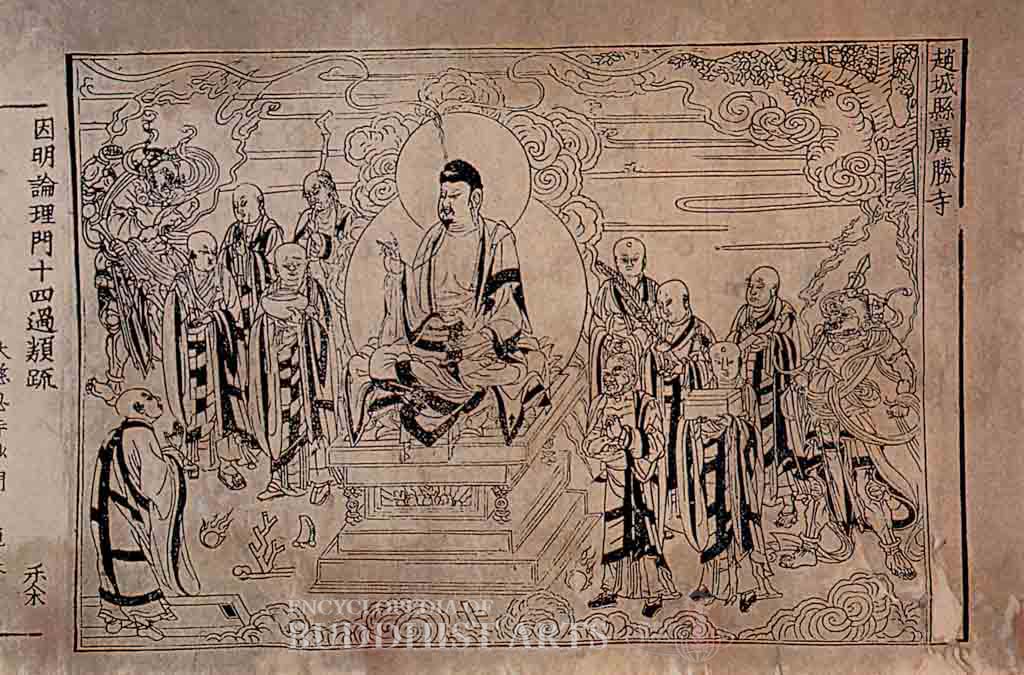
Guangsheng Temple: Frontispiece of the Zhaocheng Jin Tripitaka
Print on paper
Guangsheng Temple: Frontispiece of the Zhaocheng Jin Tripitaka
CHINA, Shanxi, Linfen; Yuan dynasty
This artwork, printed on yellow paper, is the frontispiece for a Chinese canon that was acquired in 1933 at Guangsheng Temple in Zhaocheng county. The name of the temple is also written on the top right corner of the frontispiece. The Zhaocheng Jin Tripitaka, thought to be the first replica of the Kaibao Tripitaka, was named after Zhaocheng county and the Jin dynasty (1115–1234) when the Tripitaka was created.
Historical records state that Cui Fazhen, a female devotee, organized the effort to raise money for the creation of the canon. The carving of the canon onto woodblocks was initiated at the Tianning Temple in Jiezhou (present day Yuncheng), Shanxi in 1148, and was completed in 1178. Three years later, Cui moved the entire collection of 168,113 woodblocks, which are equivalent to nearly 7,000 fascicles in print, to Zhongdu (present day Beijing). Several repairs and amendments were made to the woodblocks during the Yuan dynasty (1271–1368).
Monks from Guangsheng Temple traveled to Zhongdu to print the canon, which was then sent back to the temple. The frontispiece was added at the Pang Sutra Printing Workshop. The surviving canon consists of 4,700 fascicles. Of these, 4,541 fascicles are kept in the National Library in Beijing, and 125 fascicles are at the Shanxi Museum.
The frontispiece portrays Sakyamuni Buddha seated in a full lotus position on a Sumeru throne. Disciples and Dharma protectors stand on either side of the throne. A monk in the lower left corner listens to the Dharma with his palms joined in reverence. In the background, there are tufts and lines of clouds.
For more details, go to the Encyclopedia of Buddhist Arts: Painting A-H, page 291.
Cite this article:
author = Hsingyun and Youheng and Youlu and Wilson, Graham and Manho and Mankuang and Huntington, Susan,
booktitle = {Encyclopedia of Buddhist Arts: Painting A-H},
pages = 291,
title = {{Guangsheng Temple: Frontispiece of the Zhaocheng Jin Tripitaka}},
volume = 14,
year = {2016}}