
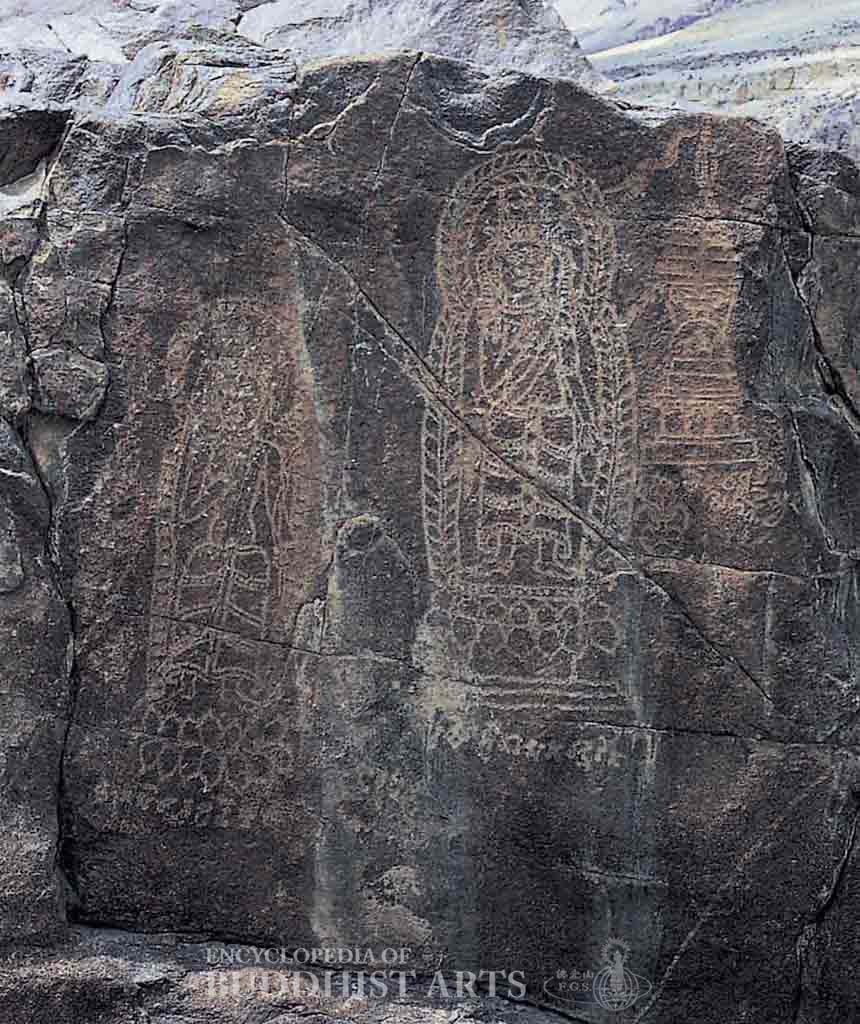
Chilas Rock Carvings: Standing Bodhisattvas
Chilas Rock Carvings: Standing Bodhisattvas
PAKISTAN, Gilgit-Baltistan
These engravings were found along the riverbank of the Indus River near Chilas in the region of Gilgit Baltistan. They are likely dated to the 5th century. Pebble walls within the premises stretch over 100 km, with over 50,000 line engravings and 5,000 inscriptions dating from the Neolithic period to the 16th century. The Indus River basin was part of a route of the Silk Road, and therefore a large number of Buddhist engravings dating from the 1st to 8th century can be found. They include images of stupas, Bodhisattvas, and temple architecture. Most of these were produced by traveling merchants and monks from China, Central Asia, and India, including many carvings by the locals and cartouches inscribed with names of the donors and devotional inscriptions.
In this picture, the images of standing Bodhisattvas are engraved in the center and on the left, with a stupa on the right. The two Bodhisattvas are depicted similarly, wearing headdresses and long waist cloths with pleating in the center and arc patterns on the sides. The nimbuses and aureoles are connected and edged with a flame pattern. The Bodhisattva in the center wears a stole draped across one shoulder, has a thick waist, and holds a vase in the left hand. The stupa sits on a Sumeru throne and has stacked rings that narrow with progressive height along the spire. The top of the canopy has flowing streamers.
For more details, go to the Encyclopedia of Buddhist Arts: Caves A-E, page 204.
Cite this article:
author = Hsingyun and Youheng and Johnson, Peter and Mankuang and Huntington, Susan and Edson, Gary and Neather, Robert,
booktitle = {Encyclopedia of Buddhist Arts: Caves A-E},
pages = 204,
title = {{Chilas Rock Carvings: Standing Bodhisattvas}},
volume = 5,
year = {2016}}