
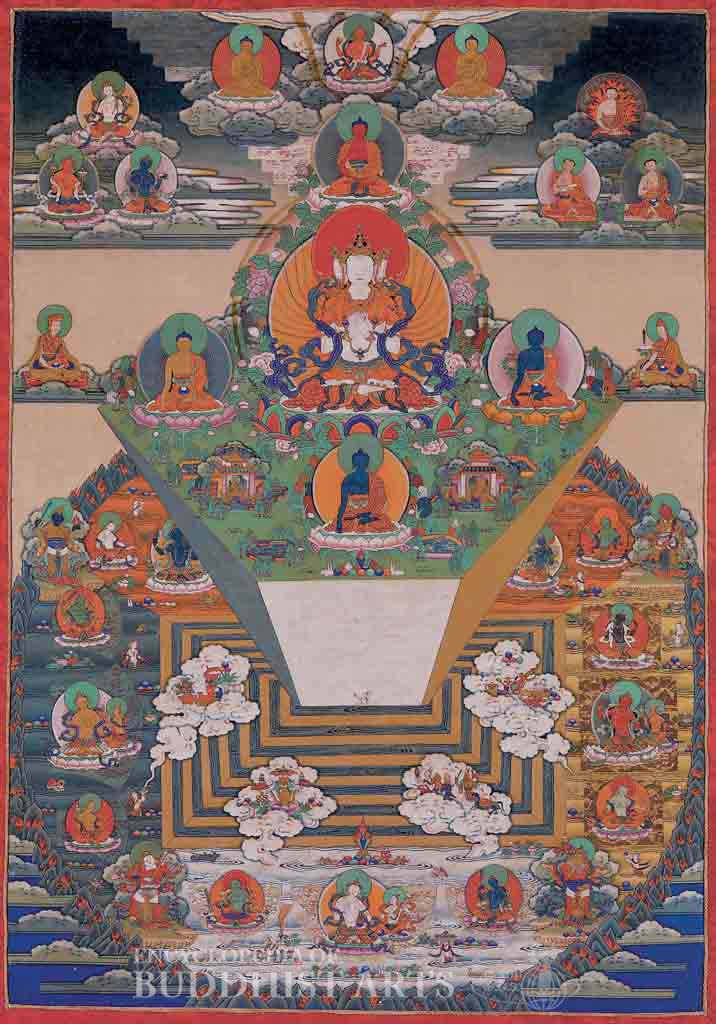
Trongsa Dzong: Buddhist Cosmology
Ink and color on cotton

Trongsa Dzong: Buddhist Cosmology - Vairocana
Trongsa Dzong: Buddhist Cosmology
BHUTAN, Trongsa
This thangka is based on the cosmological system described in the Abhidharmakosa Sastra. Mount Sumeru, an inverted pyramid, stands in the center, surrounded by seven layers of golden mountain ranges separated by seas. A ring of iron mountains forms the outer border; thus, the mountains and seas are collectively known as the “nine mountains and eight seas.” Within the boundary of the iron mountains there are four large continents: white Purvavideha, blue Jambudvipa, red Aparagodaniya, and gold Uttarakuru. Bodhisattvas sit on lotus thrones above each continent; the Four Heavenly Kings stand on the borders between them. White clouds issue out of three of the continents, supporting offerings including the eight auspicious symbols.
Atop Mount Sumeru is Trayastrimsa Heaven. The central figure is the white, Four-Headed Vairocana Buddha, sitting in full lotus position on a lotus throne and forming the Dharmacakra (Dharma wheel) mudra. Vairocana is flanked by Sakyamuni Buddha on the left and Medicine Buddha on the right. Aksobhya Buddha is below the central figure. Amitabha Buddha sits above Vairocana’s nimbus. At the apex of the picture is Prajnaparamita, accompanied by two golden Buddhas with red aureoles. White-bodied Avalokitesvara Bodhisattva, red Manjusri Bodhisattva, and blue Vajrapani Bodhisattva are depicted in the upper left corner. The upper right corner contains a seated Buddha with a flaming mandorla and two red-robed figures holding a sutra and a bowl respectively. Geometric patterns separate the three groups of figures.
For more details, go to the Encyclopedia of Buddhist Arts: Painting P-Z, page 942.
Cite this article:
author = Hsingyun and Youheng and Youlu and Wilson, Graham and Manho and Mankuang and Huntington, Susan,
booktitle = {Encyclopedia of Buddhist Arts: Painting P-Z},
pages = 942,
title = {{Trongsa Dzong: Buddhist Cosmology}},
volume = 16,
year = {2016}}