
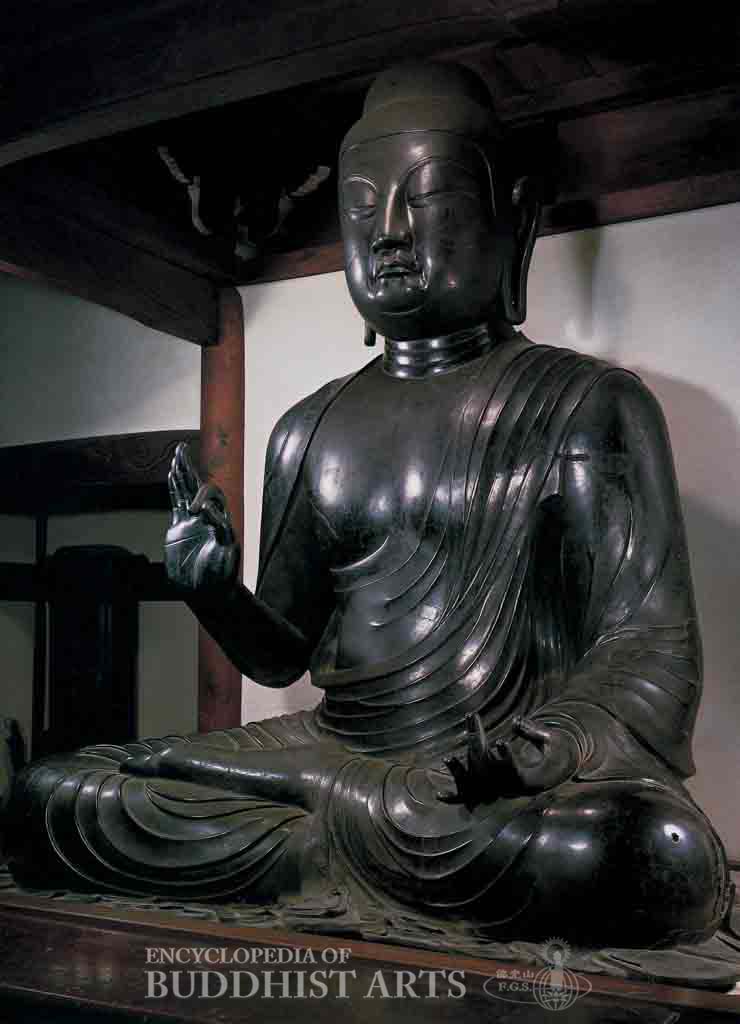
Kanimanji Temple Main Hall: Sakyamuni Buddha
Gilt copper alloy
Kanimanji Temple Main Hall: Sakyamuni Buddha
JAPAN, Kyoto; Nara period
There are differing opinions about the origin of this statue; one is that it came from a nearby temple. Initial excavations of the Kanimanji Temple have lead experts to believe the temple was built around the late 7th century and that the Buddha had been the main statue. It was listed as a National Treasure in 1953.
Although the figure is said to be Sakyamuni Buddha, it lacks an urna and makes the vitarka (teaching) mudra, which is generally associated with other figures. Curved brows hover over the figures’s deep eyelids and the eyes are slightly open. The mouth is turned down in a solemn expression. Over the broad shoulders, the monastic robes drape about the body in angular folds that are sharply defined. The Buddha sits in full lotus position with the left hand resting palm up over the knee. Webbing, considered one of the Buddha’s Thirty-Two Marks of Excellence, are visible between the fingers. The statue is believed to be created some time during the late 7th to early 8th century.
For more details, go to the Encyclopedia of Buddhist Arts: Sculpture G-M, page 520.
Cite this article:
author = Hsingyun and Youheng and Lovelock, Yann and Chou, Yuan and Huntington, Susan and Edson, Gary and Neather, Robert,
booktitle = {Encyclopedia of Buddhist Arts: Sculpture G-M},
pages = 520,
title = {{Kanimanji Temple Main Hall: Sakyamuni Buddha}},
volume = 11,
year = {2016}}