

Ruiguang Temple Pagoda: Reliquary Container with the Four Heavenly Kings
Ink and color on wood

Ruiguang Temple Pagoda: Reliquary Container with the Four Heavenly Kings - Dhrtarastra (east)

Ruiguang Temple Pagoda: Reliquary Container with the Four Heavenly Kings - Virupaksa (west)
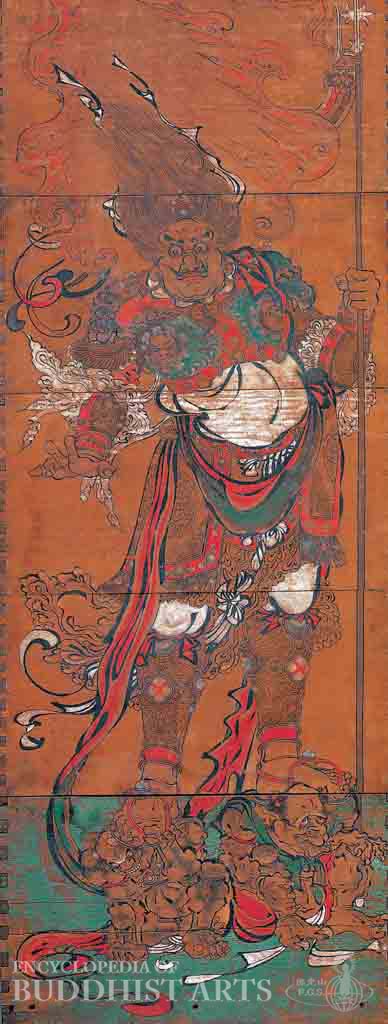
Ruiguang Temple Pagoda: Reliquary Container with the Four Heavenly Kings - Virudhaka (south)
Ruiguang Temple Pagoda: Reliquary Container with the Four Heavenly Kings
CHINA, Jiangsu, Suzhou; Northern Song dynasty
This container was discovered in 1978 and is made from ginko wood, with a square truncated pyramidal top and five layers of inner walls.
The wooden box once contained a relic banner, and the four outer walls are painted with the Four Heavenly Kings as a symbol of protection; the Four Heavenly Kings are said to reside on the four sides of Mount Sumeru while guarding the world.
The Heavenly Kings are dressed in armor and hold various postures. Dhrtarastra, Heavenly King of the East, has his hair tied up in a double topknot, with his right hand placed on his waist, and his left holding a sword. Virudhaka, Heavenly King of the South, holds a halberd in his left hand as his right arm bends and extends at the elbow to express strength. Virupaksa, Heavenly King of the West, wears a crown with red tassels, and holds an axe in both hands. Vaisravana, Heavenly King of the North, wears a high topknot and a jeweled crown, holding a pagoda in his left hand, while raising his right hand and bending his arm at the elbow.
There are traces of the style of Wu Daozi from the Tang dynasty (618–907) throughout the work, such as in the intricate sketching of the armor. Similarly, their robes are sketched with an expansive and broad style, with the thickness of the lines varying significantly. Although painted at the beginning of the Song dynasty (960–1279), this box is significant for understanding the Buddhist paintings from Jiangnan (region south of the Yangtze River) during the transition from Five Dynasties (907–960) to the Song dynasty.
For more details, go to the Encyclopedia of Buddhist Arts: Artifacts, page 290.
Cite this article:
author = Hsingyun and Youheng and Youji and Pokorski, Stefanie and Mankuang and Fan, Wen,
booktitle = {Encyclopedia of Buddhist Arts: Artifacts },
pages = 290,
title = {{Ruiguang Temple Pagoda: Reliquary Container with the Four Heavenly Kings}},
volume = 18,
year = {2016}}