
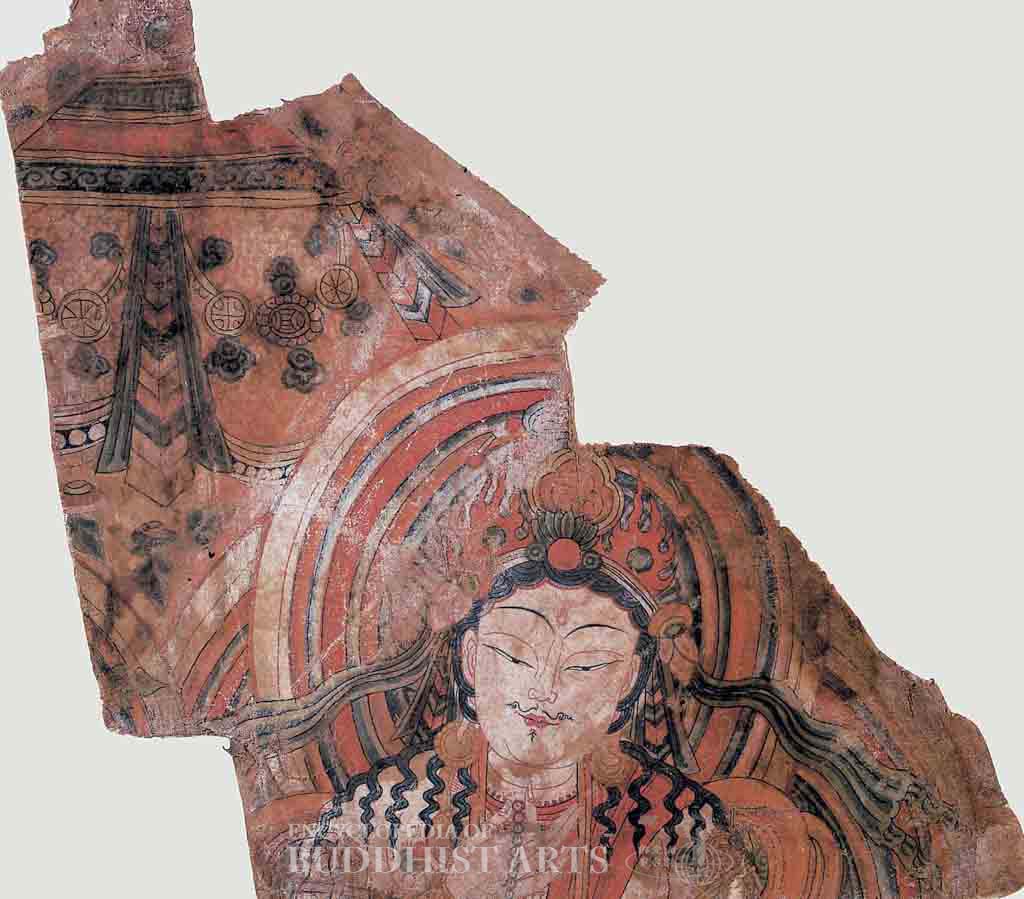
Tuyoq Caves: Bodhisattva
Ink and color on linen
Tuyoq Caves: Bodhisattva
CHINA, Xinjiang, Turpan; Tang dynasty
This fragment of a painting of a Bodhisattva was discovered in the Tuyoq Caves by a Japanese expedition between 1908 and 1909. Only the upper half of the Bodhisattva is visible. The figure has a white face, narrowed eyes, a thin mustache, and an urna. Curled black hair hangs over the shoulders in ringlets. The headdress is adorned with ribbons that flutter out to the sides. The head is encircled by a nimbus composed of colored rings. A hand with slender fingers holds up a string of prayer beads in front of the chest. An elegant canopy is visible in the upper left section of the fragment. The image is elegantly painted and brightly colored. The style is similar to that seen in murals in the Mogao Caves.
For more details, go to the Encyclopedia of Buddhist Arts: Painting P-Z, page 945.
Cite this article:
author = Hsingyun and Youheng and Youlu and Wilson, Graham and Manho and Mankuang and Huntington, Susan,
booktitle = {Encyclopedia of Buddhist Arts: Painting P-Z},
pages = 945,
title = {{Tuyoq Caves: Bodhisattva}},
volume = 16,
year = {2016}}