

Chan Lineage Scroll
Ink and color on silk
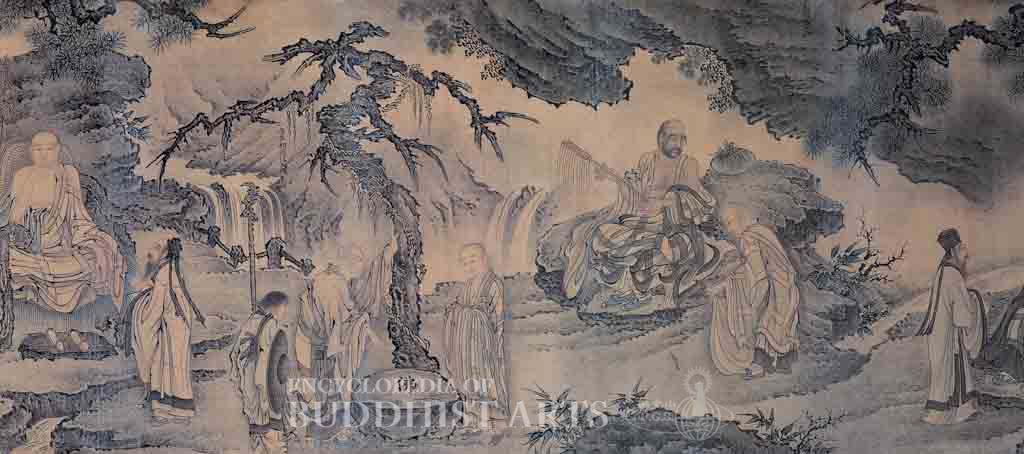
Chan Lineage Scroll (detail)
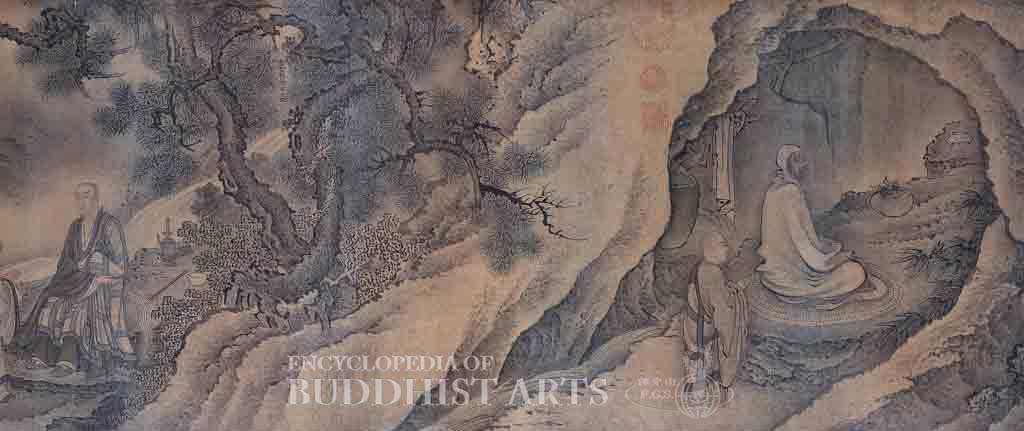
Chan Lineage Scroll (detail)

Chan Lineage Scroll - Sengcan and Daoxin
Chan Lineage Scroll
CHINA; Ming dynasty
This scroll painted by Dai Jin depicts the first six patriarchs of the Chan school: Bodhidharma, Huike, Sengcan, Daoxin, Hongren, and Huineng. The images are arranged sequentially from right to left, and illustrate the transmission of the lineage from master to disciple.
On the far right, Bodhidharma is shown sitting within a cave, gazing at the wall. Huike stands reverently behind him, his legs buried in the snow. In the next image, Huike is seated beneath a tree, and Sengcan, still a layman, stands before him. In the third section, Sengcan, now portrayed as a monk, is seated on a rock holding a whisk, and teaching the Dharma to Daoxin. In the fourth section, Daoxin and Hongren stand beside a rock engraved with the Chinese character for “Buddha.” In the next illustration, Hongren is depicted sitting on a large rock. Huineng, portrayed as a layman, stands before him. On the far left, Huineng, now a monk, is shown sitting on a chair reaching out towards a practitioner who wears a long robe and a bamboo hat.
The figures are painted against a background of rocks, pine trees, cypresses, and waterfalls. The precise, detailed style seems to have been influenced by the Southern Song dynasty (1127–1279) artists Liu Songnian and Li Tang, both known for their intricate images of figures within landscapes. Smooth lines are used to outline the figures, while the rocks and trees are given a rough, jagged appearance.
For more details, go to the Encyclopedia of Buddhist Arts: Painting A-H, page 142.
Cite this article:
author = Hsingyun and Youheng and Youlu and Wilson, Graham and Manho and Mankuang and Huntington, Susan,
booktitle = {Encyclopedia of Buddhist Arts: Painting A-H},
pages = 142,
title = {{Chan Lineage Scroll}},
volume = 14,
year = {2016}}