
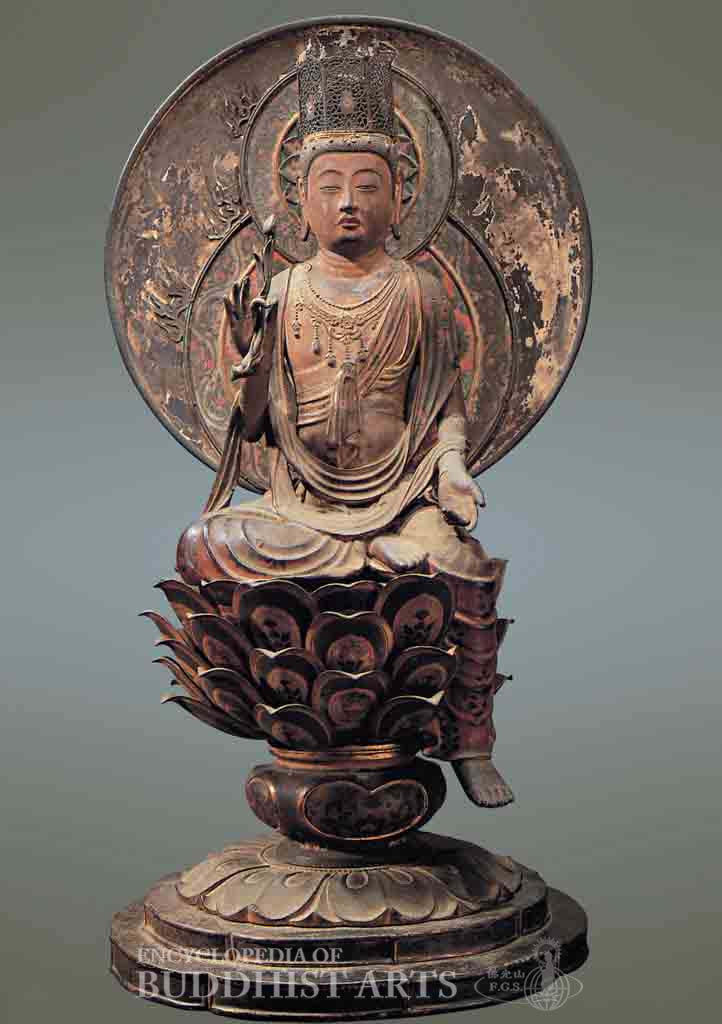
Kakuanji Temple: Akasagarbha Bodhisattva
Wood
Kakuanji Temple: Akasagarbha Bodhisattva
JAPAN, Nara, Yamatokoriyama; Nara period
The statue is the earliest surviving figure of Akasagarbha Bodhisattva in Japan and is listed as an Important Cultural Property. The style and the wood-core dry lacquer technique used to create it suggest that it dates from the end of the Nara period (710–794). A later inscription records repair work done in 1282.
The Bodhisattva wears a tall openwork crown, which feature the Five Dhyani Buddhas. The raised right hand of the figure holds a lotus bud inlaid with jewels. The left hand is opened in varada (wish-granting) mudra and the left leg hangs over the deep lotus throne in the relaxation posture. Stoles fall from the shoulders to swathe the arms, which then loops to the lap, demonstrating at the same time, the thickness of the dry-lacquer features. The circular mandorla behind the figure encloses a flame-decorated nimbus and aureole.
For more details, go to the Encyclopedia of Buddhist Arts: Sculpture G-M, page 517.
Cite this article:
author = Hsingyun and Youheng and Lovelock, Yann and Chou, Yuan and Huntington, Susan and Edson, Gary and Neather, Robert,
booktitle = {Encyclopedia of Buddhist Arts: Sculpture G-M},
pages = 517,
title = {{Kakuanji Temple: Akasagarbha Bodhisattva}},
volume = 11,
year = {2016}}