
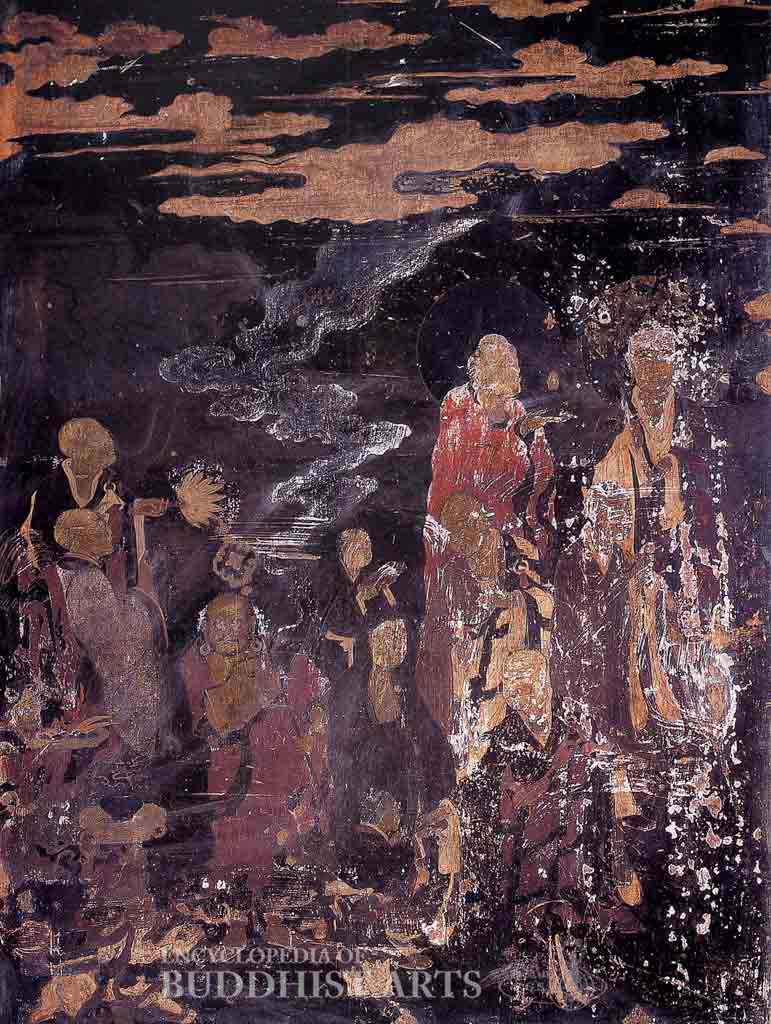
Dajue Palace Main Hall: Eighteen Arhats (east wall)
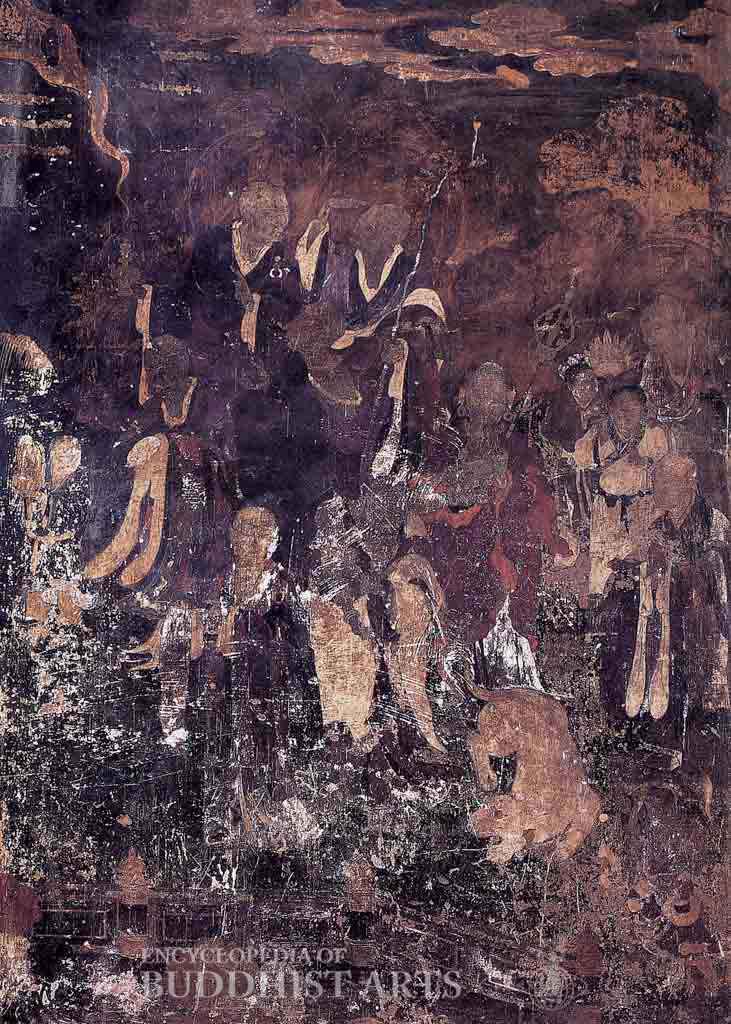
Dajue Palace Main Hall: Eighteen Arhats (west wall)
Dajue Palace Main Hall: Eighteen Arhats
CHINA, Yunnan, Lijiang; Ming dynasty
Dajue Palace was built during the Wanli period (1573–1620), and has since undergone many renovations and reconstructions. Originally, there were nine murals in the main hall, but only six remain. They portray both Buddhist and Daoist figures.
These images of the Eighteen Arhats are painted on the side walls of the palace, with the Arhats divided into groups of nine on each wall. The details in the murals are partially obscured by damage. Some of the Arhats have fine, gentle features, while others have high-bridged noses and big beards. They are shown standing in loosely ordered groups. Some are in solitary contemplation, others appear to speak and listen to one another. Attendants and figures making offerings are shown among the Arhats. Floating clouds are painted at the top of the murals.
For more details, go to the Encyclopedia of Buddhist Arts: Painting A-H, page 184.
Cite this article:
author = Hsingyun and Youheng and Youlu and Wilson, Graham and Manho and Mankuang and Huntington, Susan,
booktitle = {Encyclopedia of Buddhist Arts: Painting A-H},
pages = 184,
title = {{Dajue Palace Main Hall: Eighteen Arhats}},
volume = 14,
year = {2016}}