
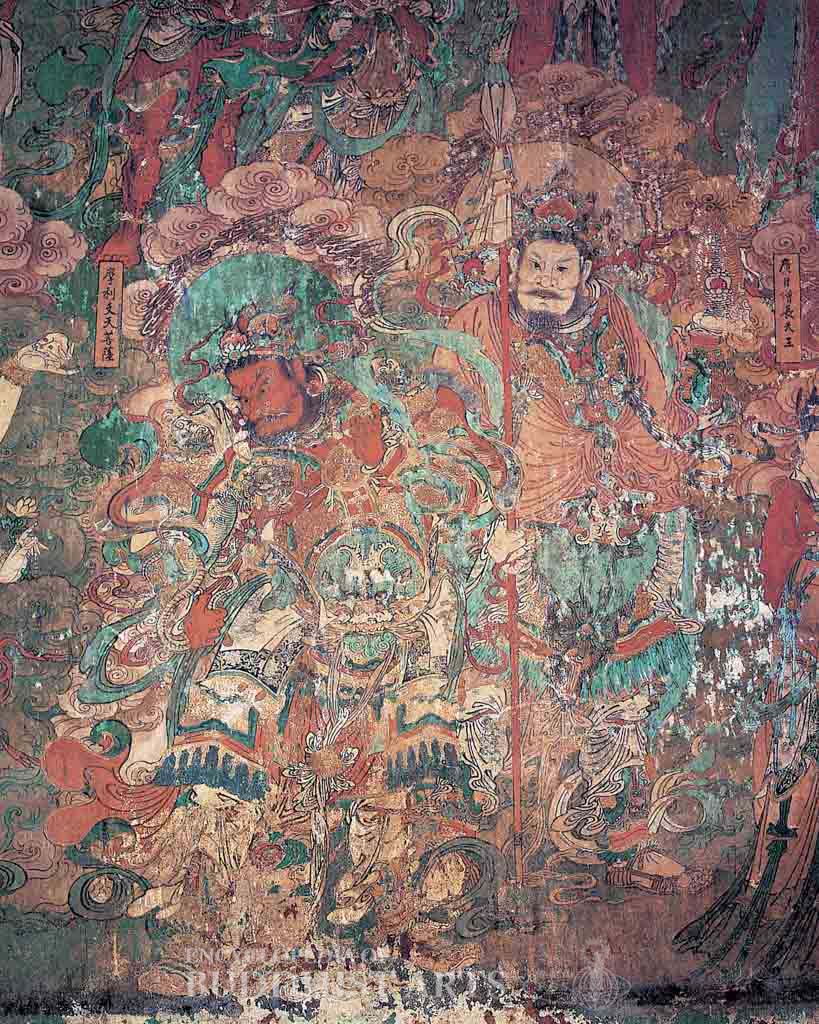
Pilu Temple Vairocana Hall: Four Heavenly Kings
Pilu Temple Vairocana Hall: Four Heavenly Kings
CHINA, Hebei, Shijiazhuang; Ming dynasty
These images are depicted in the upper register of the north wall in the Vairocana Hall of Pilu Temple. Dhrtarastra, Heavenly King of the East and Vaisravana, Heavenly King of the North are painted on the right, while Virupaksa, Heavenly King of the West and Virudhaka, Heavenly King of the South are shown on the left. According to the scriptures, the Four Heavenly Kings live at the foot of Mount Sumeru and each guard one of the four directions.
The Heavenly Kings wear crowns and have thick eyebrows, furrowed brows, and wide eyes. They are dressed in colorful robes and decorative armor. Virupaksa holds a jewel and a snake that coils around his arms. Vaisravana supports a pagoda with his left hand and carries a banner with his right. Swirling colored clouds surround the figures.
During the Ming (1368–1644) and Qing (1644–1911) dynasties, the iconographic appearance of the kings in paintings and murals became standardized. In this mural, the kings have the traditional formidable, majestic appearances and hold the objects that they are commonly associated with. Their robes and stoles, depicted with delicate curving lines and appearing to flutter in the breeze, are skillfully painted in the style pioneered by the renowned Tang artist Wu Daozi.
For more details, go to the Encyclopedia of Buddhist Arts: Painting P-Z, page 744.
Cite this article:
author = Hsingyun and Youheng and Youlu and Wilson, Graham and Manho and Mankuang and Huntington, Susan,
booktitle = {Encyclopedia of Buddhist Arts: Painting P-Z},
pages = 744,
title = {{Pilu Temple Vairocana Hall: Four Heavenly Kings}},
volume = 16,
year = {2016}}