
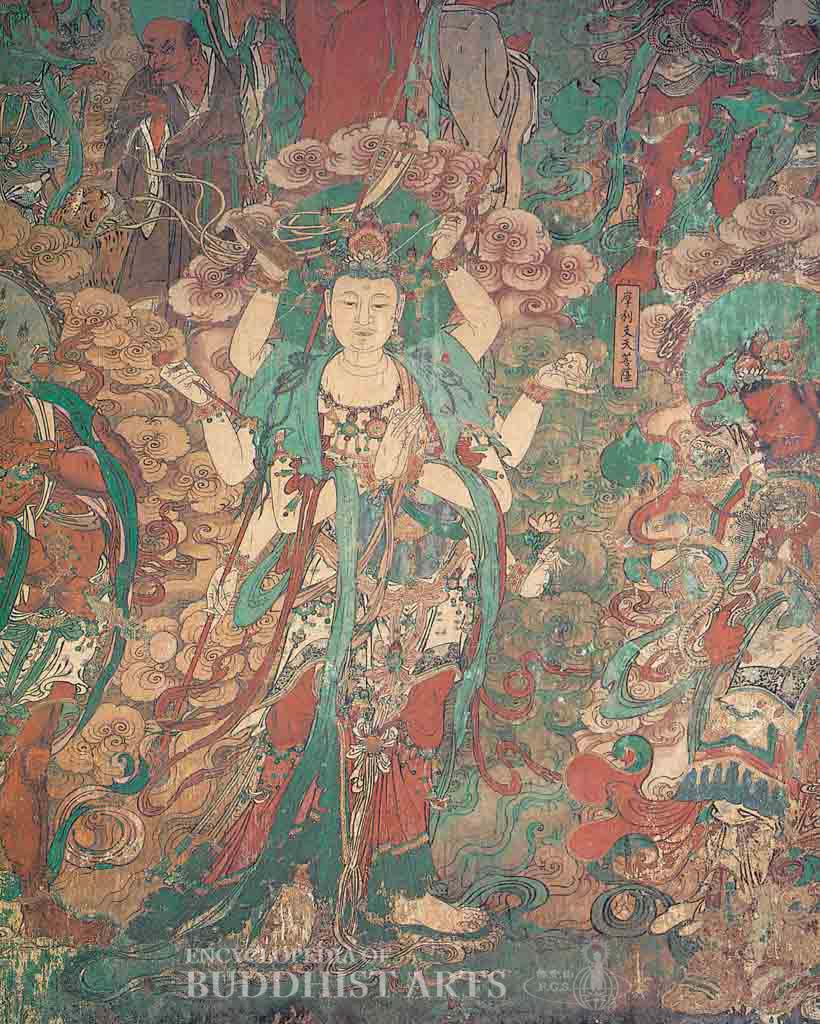
Pilu Temple Vairocana Hall: Marici
Pilu Temple Vairocana Hall: Marici
CHINA, Hebei, Shijiazhuang; Ming dynasty
This figure on the lower left section of the north wall in Vairocana Hall is identified by an inscription as Marici Bodhisattva. The Marici Sutra states that the Bodhisattva possesses the power of invisibility. In Sanskrit, Marici means “shining” or “mirage.”
The Bodhisattva wears an ornate headdress and has an urna between the eyebrows. Long ornaments adorn the body while fluttering stoles are draped over the shoulders and arms. The delicately folded dhoti has patterned hems and is decorated with beaded ornaments. Marici has eight arms; two of them joining palms in front of the chest while the remaining six hold Dharma implements including a lotus, a seal, and an arrow. The figure’s feet rest on lotus pedestals.
For more details, go to the Encyclopedia of Buddhist Arts: Painting P-Z, page 745.
Cite this article:
author = Hsingyun and Youheng and Youlu and Wilson, Graham and Manho and Mankuang and Huntington, Susan,
booktitle = {Encyclopedia of Buddhist Arts: Painting P-Z},
pages = 745,
title = {{Pilu Temple Vairocana Hall: Marici}},
volume = 16,
year = {2016}}