
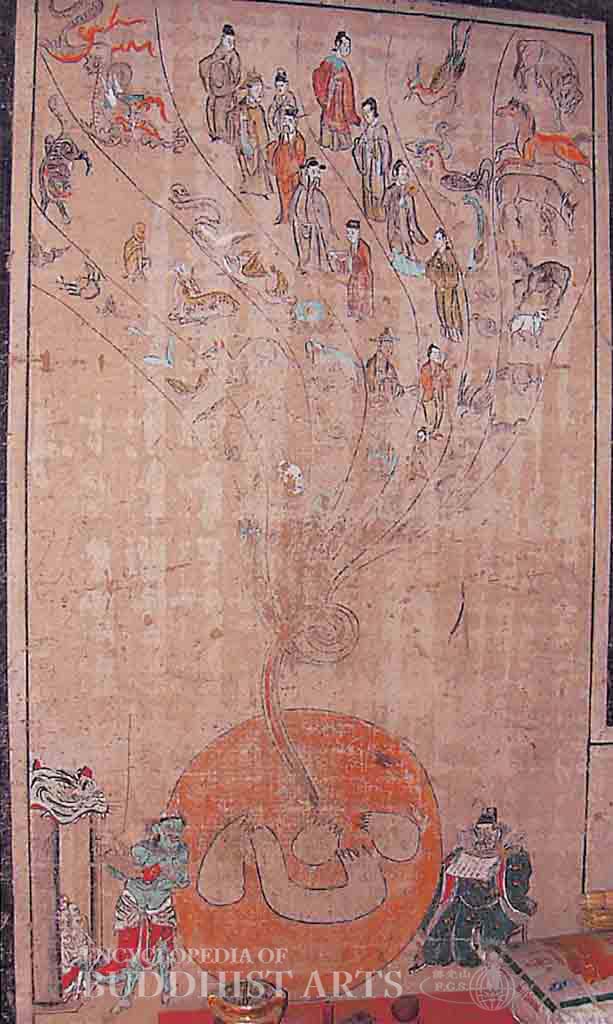
Dongwenshu Temple Great Hero Hall: Water and Land Dharma Service Murals - Six Realms of Existence
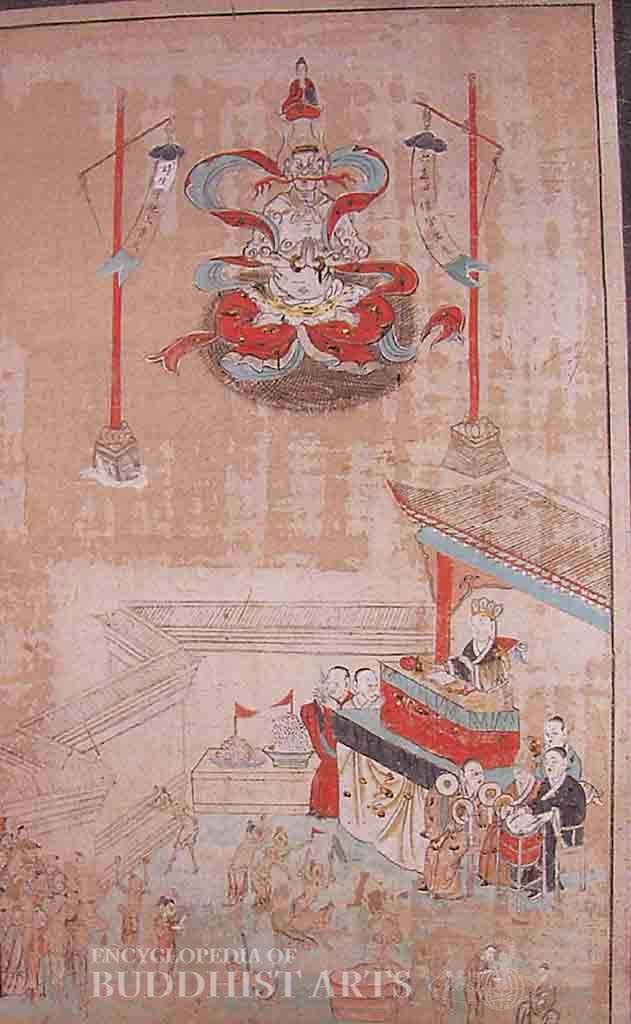
Dongwenshu Temple Great Hero Hall: Water and Land Dharma Service Murals - Yogacara Offering Service
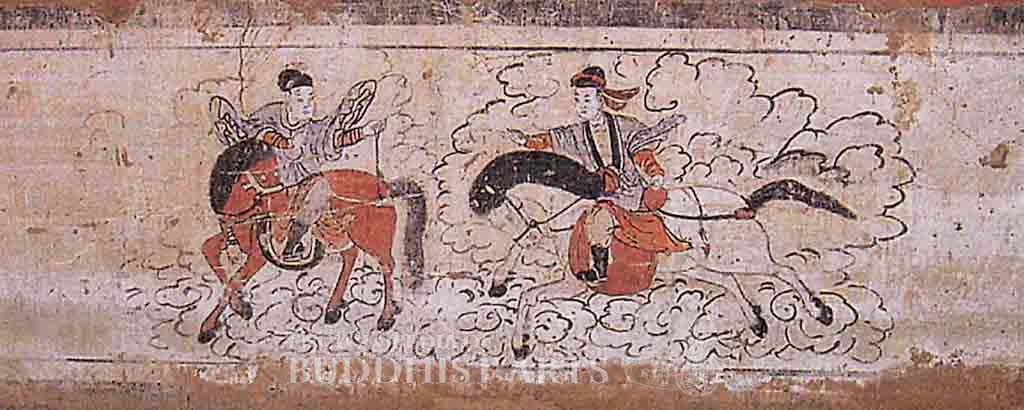
Dongwenshu Temple Great Hero Hall: Water and Land Dharma Service Murals - Messengers
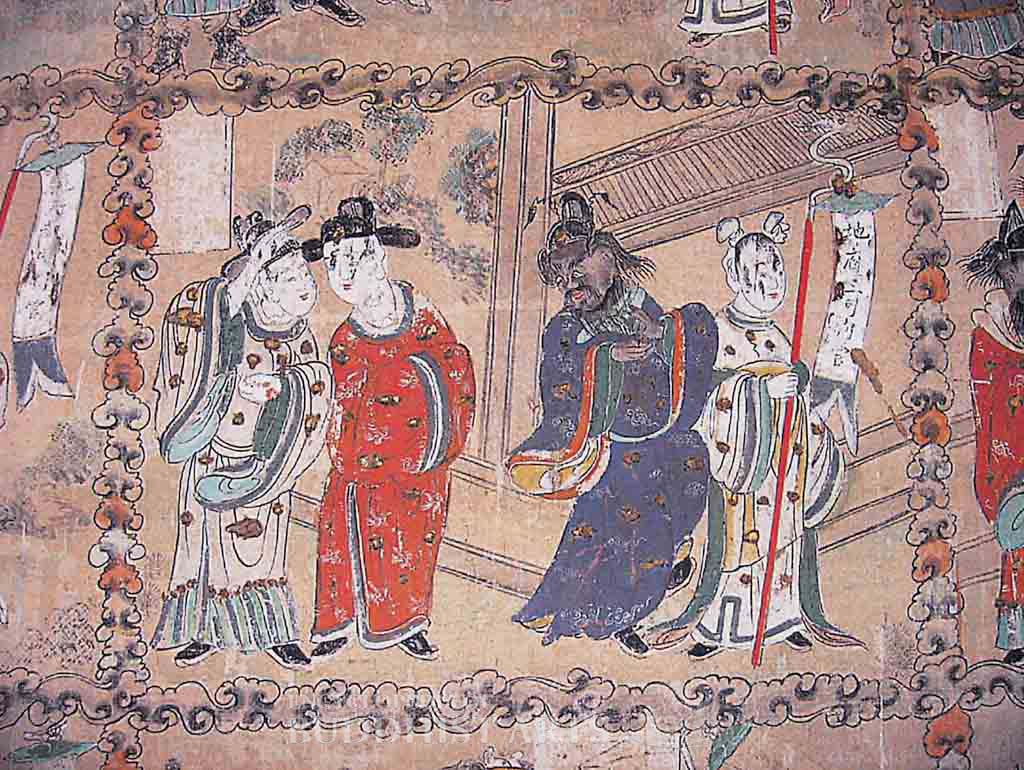
Dongwenshu Temple Great Hero Hall: Water and Land Dharma Service Murals - Judges
Dongwenshu Temple Great Hero Hall: Water and Land Dharma Service Murals
CHINA, Shanxi, Xinzhou; Qing dynasty
These murals are painted on the side walls of the Great Hero Hall of Dongwenshu Temple. The Water and Land Dharma Service was conceived of by Emperor Wu (reigned 502–549) of the Liang dynasty, who dreamed of a monk telling him of a way to ease the immeasurable sufferings of sentient beings by holding a special Dharma service, inviting enlightened beings and making offerings. According to the Records of Origin on Things and Affairs, the service was first performed in 508 in Jinshan Temple, while the Chronicle of the Buddha and Patriarchs dates the first service to 505.
The images on the walls are divided into distinct sections. Next to the door and below the window on the south wall, there are depictions of the triumph envoy, the Buddha of the Mind, and the temple where the first service was held. These images are commonly seen in Water and Land scroll paintings, but are rarely found in murals.
In the bottom section of the image of the six realms of existence, there is a red circle containing the Chinese character for “mind.” Beside it on the right, a magistrate dressed in official’s robes sits in a chair and reads a record. On the other side, a green ghost dressed in a red dhoti is shown. To the left of the ghost, a group of figures stand beneath a small door topped with an animal head. The six realms of existence, separated by black lines, emanate upwards out of “mind.” Within the segments there are numerous small animals, humans, and ghosts. This image is an interesting symbolic representation of mind-determining rebirth in one of the six realms.
The illustration of the Yogacara Offering Service is primarily based on a description written in the Ulka Mukha Preta Sutra. According to the sutra, hungry ghosts have thin bodies, flaming mouths, and throats as thin as a needle. In the lower register, a judge sits at a tall table, accompanied by attendants. Small, ghostly figures stand before the judge. At the top of the painting, an ugly ghost with a flaming mouth sits in lotus position and joins his palms. A Buddha dressed in a red monastic robe sits on top of the ghost’s head.
For more details, go to the Encyclopedia of Buddhist Arts: Painting A-H, page 195.
Cite this article:
author = Hsingyun and Youheng and Youlu and Wilson, Graham and Manho and Mankuang and Huntington, Susan,
booktitle = {Encyclopedia of Buddhist Arts: Painting A-H},
pages = 195,
title = {{Dongwenshu Temple Great Hero Hall: Water and Land Dharma Service Murals}},
volume = 14,
year = {2016}}