
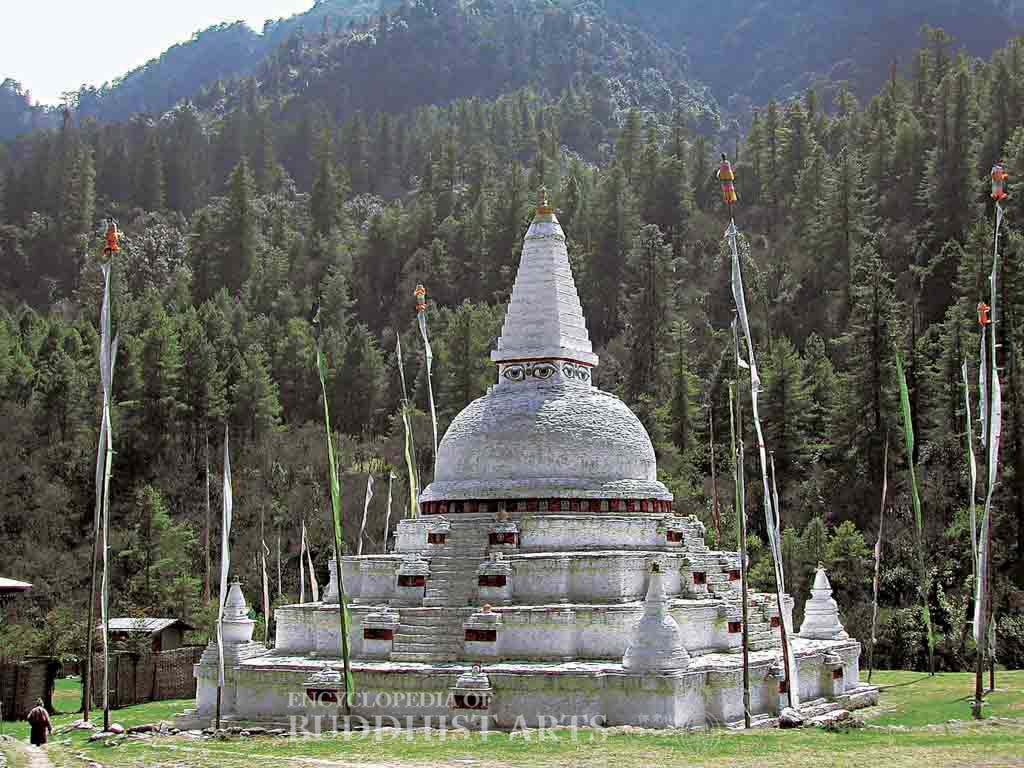
Chendebji Stupa
Chendebji Stupa
BHUTAN, Trongsa
This stupa was built in the 18th century by Shida, a Tibetan lama. In Bhutan there are more than 10,000 stupas, most of which are situated on mountain passes or by the roadside.
Modeled on the stupa at Swayambhunath in Nepal, the Chendebji Stupa is more than 10 m high and is made of brick and stone. The base of the stupa consists of four tiers and is square with multiple corners. At the corners of the first tier there are small stupas. There are steps in the center of each side of the remaining three tiers. The inverted bowl shape stupa body is surmounted by a square harmika, which is painted with the Buddha’s eyes on each side. The spire consists of a 13-tier pyramid, which symbolizes the 13 stages of cultivation leading to Buddhahood. They are followed by a small canopy and a finial in the form of a jewel.
For more details, go to the Encyclopedia of Buddhist Arts: Architecture A-F, page 127.
Cite this article:
author = Hsingyun and Youheng and Johnson, Peter and Mankuang and Lancaster, Lewis,
booktitle = {Encyclopedia of Buddhist Arts: Architecture A-F},
pages = 127,
title = {{Chendebji Stupa}},
volume = 1,
year = {2016}}