
Phajoding Monastery: Illustrations of Jataka Tales
Ink and color on cotton
Phajoding Monastery: Illustrations of Jataka Tales
BHUTAN, Thimphu
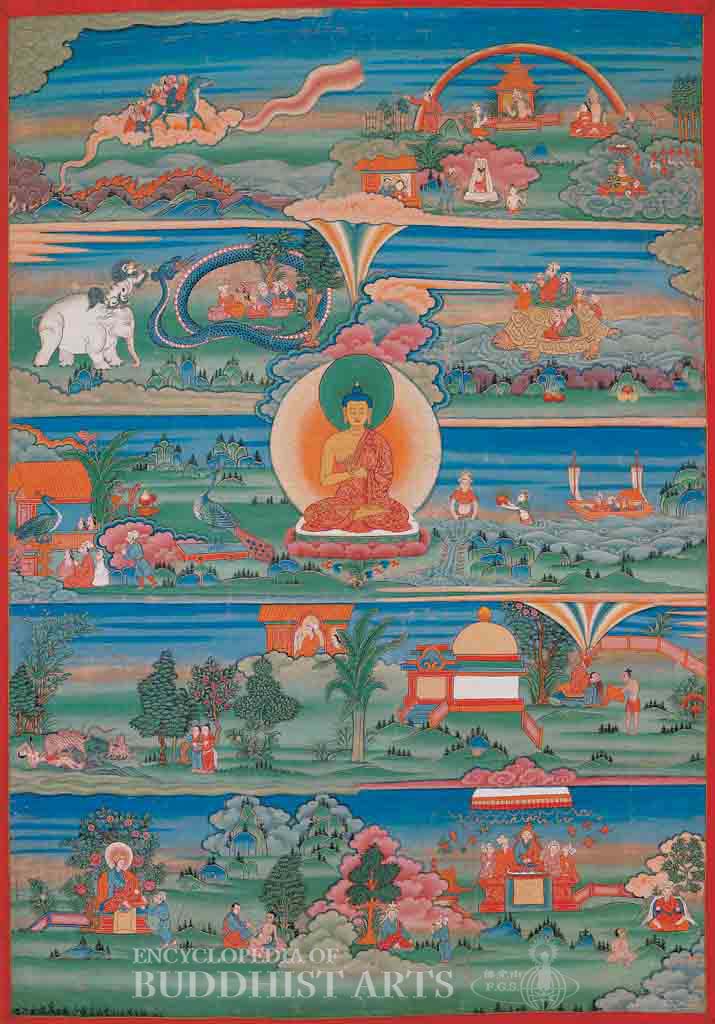
Kept in the Phajoding Monastery in Thimphu, Bhutan, this is part of a set of ten thangkas that illustrate the numerous stories of how Sakyamuni Buddha gained great merit through virtuous actions in his previous lives. The picture is divided into five horizontal sections that each contain two scenes.
The Buddha sits on a lotus throne, wearing a monastic robe draped over the left shoulder and forming the Dharmacakra (Dharma wheel) mudra. The scenes move from left to right and top to bottom. The Valahassa Jataka is depicted in the upper left corner. The horse Balahaka is shown rescuing many merchants from the burning land of the raksasis. On the right, there is a scene from the traditional Tibetan story of King Norzang, which originates from the “Wise Words of Norzang” in the Tibetan Kangyur canon. The third scene portrays the Buddha as a lion rescuing 500 merchants from a gigantic snake with the help of a white elephant.
In the fourth scene, The Buddha in a previous life as a giant turtle saves a group of merchants who had fallen into the ocean. The fifth scene is from the Mahamora Jataka, in which the Buddha was born as a peacock. The bird is perched on a stand, instructing a small gathering that includes a king and a queen. The sixth scene portrays the kindhearted Prince Donken Druba sailing in search of a wish-fulfilling jewel in order to help the poor. The Naga King rises from the ocean, offering the prince a flaming jewel.
The seventh scene, from the Prince Mahasattva Jataka, depicts Prince Mahasattva sacrificing his life to feed a hungry tigress. The eighth story is the King Candraprabha Jataka, which tells how King Dayoe cut off his head and gave it to a brahmin. The decapitated body emits a colorful radiance. The ninth scene depicts Prince Semchen Men gladly helping the sick. The prince is shown taking the pulse of a patient with an amputated leg while his father the king receives an offering from an attendant. The last scene is from the King Sibi Jataka. As a test of generosity, the disguised deity Sakra asked the king to give his flesh as alms, and the king complied without hesitation. Sakra was very pleased with the offering and gave him an elixir that restored his body. The king is depicted on the right with decapitated hands and feet. Sakra is disguised as the naked figure on the left. The king is shown with his limbs restored, sitting on a platform below a canopy.
For more details, go to the Encyclopedia of Buddhist Arts: Painting P-Z, page 740.
Cite this article:
author = Hsingyun and Youheng and Youlu and Wilson, Graham and Manho and Mankuang and Huntington, Susan,
booktitle = {Encyclopedia of Buddhist Arts: Painting P-Z},
pages = 740,
title = {{Phajoding Monastery: Illustrations of Jataka Tales}},
volume = 16,
year = {2016}}