
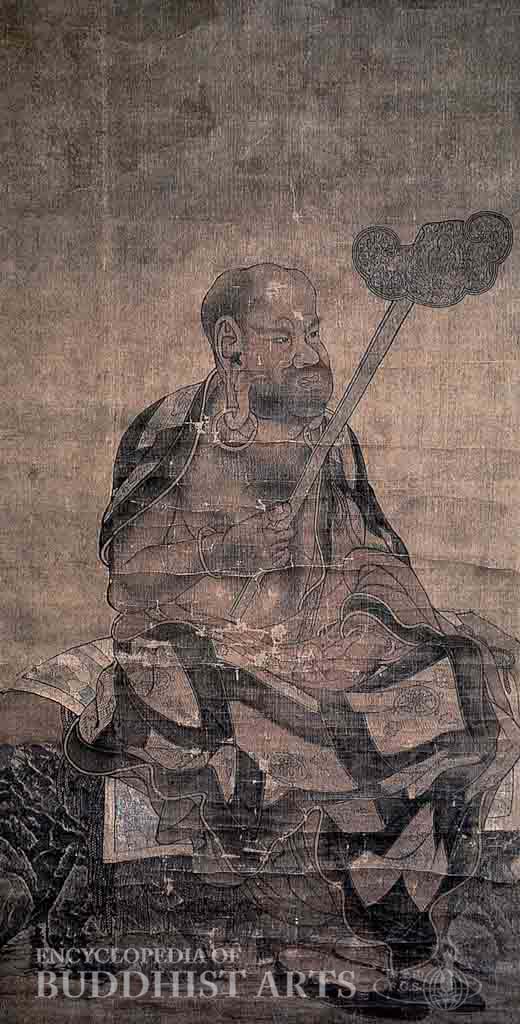
Sixteen Arhats - Kanakabharadraja
Ink and color on silk
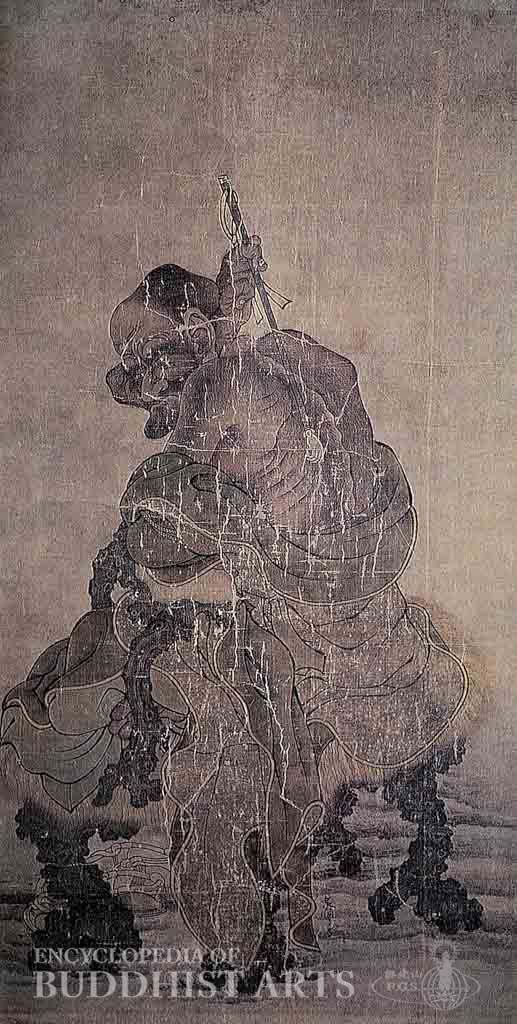
Sixteen Arhats - Kalika
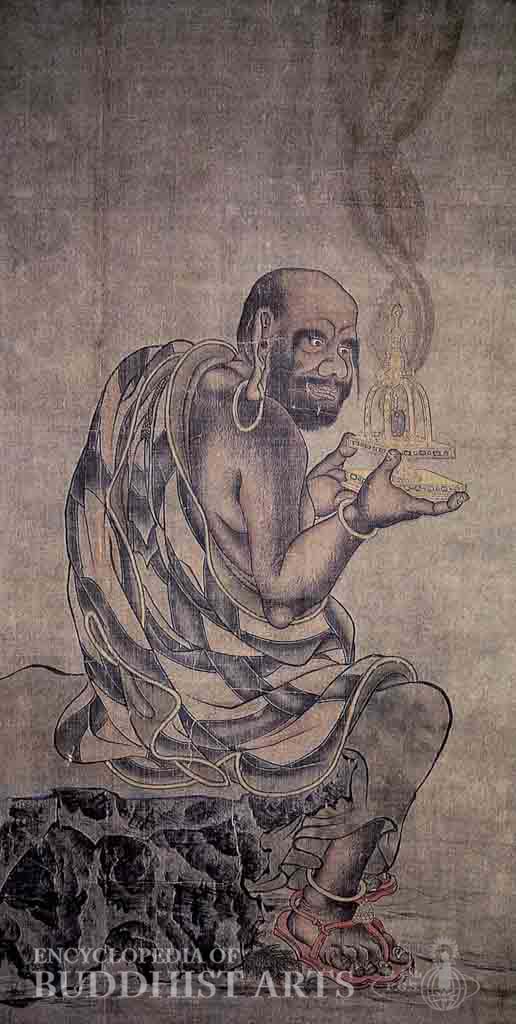
Sixteen Arhats - Bhadra
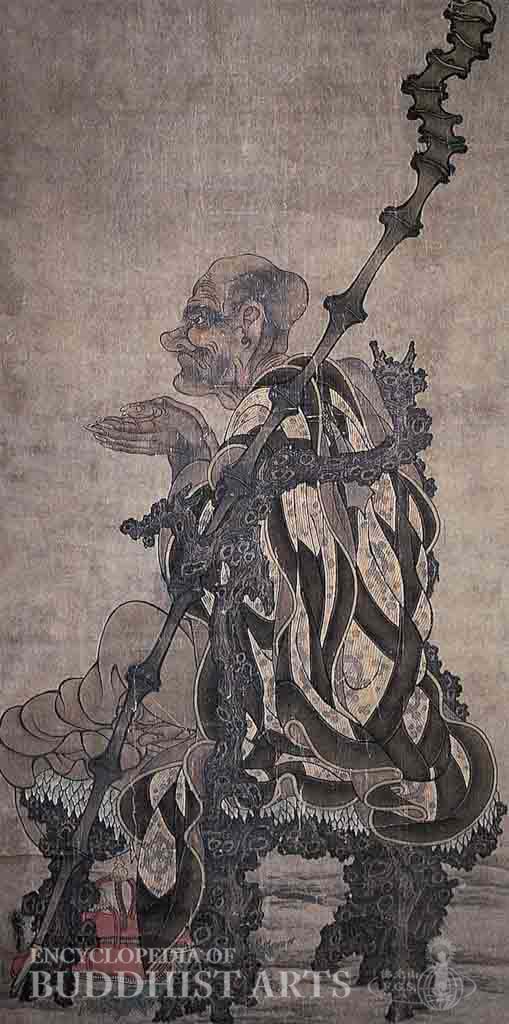
Sixteen Arhats - Nakula
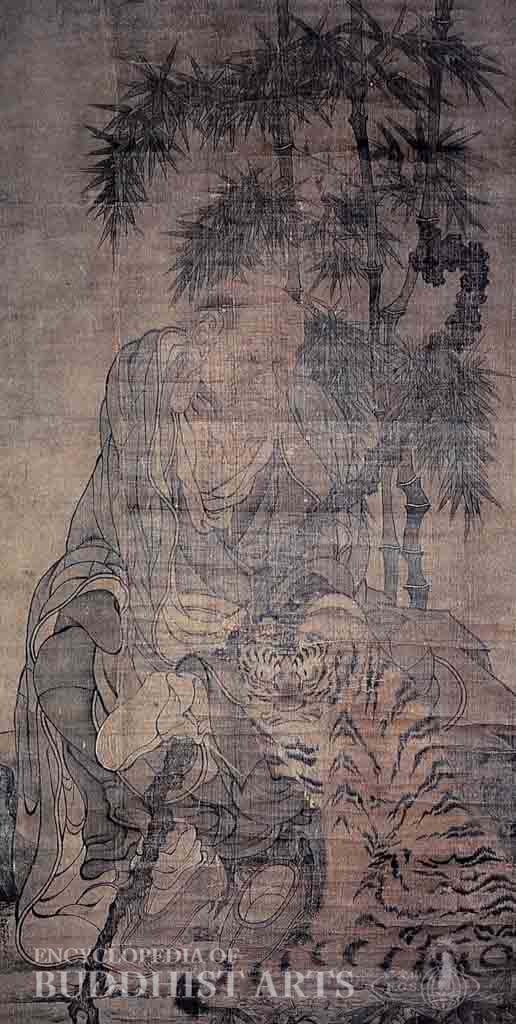
Sixteen Arhats - Pindolabharadraja
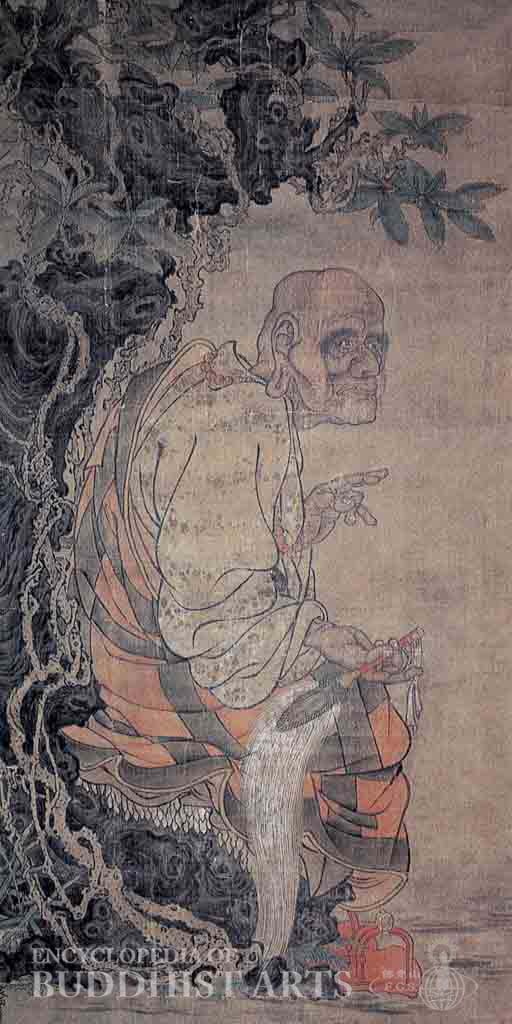
Sixteen Arhats - Kanakavatsa
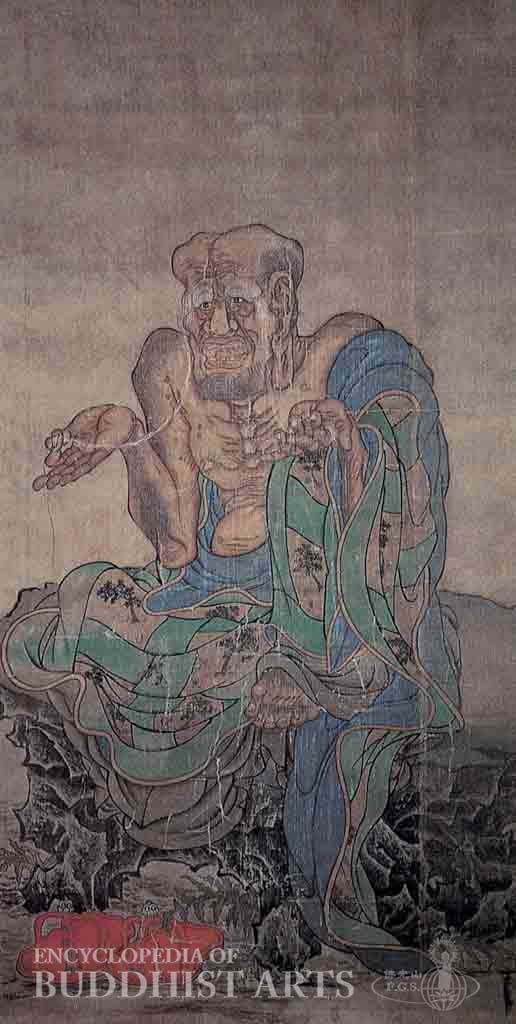
Sixteen Arhats - Jivaka

Sixteen Arhats - Bhadra (detail)

Sixteen Arhats - Nakula (detail)

Sixteen Arhats - Jivaka (detail)
Sixteen Arhats
CHINA; Southern Song dynasty
According to the Sixteen Arhats at Kodaiji Temple by Chanyue, in 1211, the monk Shunjo, founder of Sennyuji Temple, returned to Japan from China and brought 16 paintings of the Arhats with him. Each of these paintings is 129.1 cm in height and 65.7 cm in width, and carries the inscription “Sennyuji.” The Genko Shakusho states that the set was composed of eighteen paintings, but two were lost before reaching Japan. The Arhats have knobby skulls, prominent eyebrows, large noses, and long ears; they bear a close resemblance to the Arhats painted by Guanxiu, also known as Master Chanyue during the Tang dynasty (618–907). Thus, this set is possibly a Southern Song dynasty (1127–1279) copy of Guanxiu’s original illustrations. One of the more lively paintings shows the Arhat Kalika frowning intently as he uses a backscratcher with a small hand on the end. Clad in a loose, wrinkled robe, the aged Pindolabharadraja holds a staff and reaches down to pet a peaceful tiger that nuzzles against his leg. Nakula sits in a wooden chair and joins his palms. A long staff is balanced in the crook of the armrest. Kanakabharadraja examines a large ruyi (wish-fulfilling talisman). Kanakavatsa, with a protruding forehead and prominent nose, leans against the trunk of an old tree, holds a whisk in his right hand, and points with the left. Bhadra sits on a rock and stares intently at an incense burner. Jivaka holds up his hands and appears to shrug his shoulders. The figures are expressive and beautifully detailed, exemplifying the high quality of Song Buddhist art.
For more details, go to the Encyclopedia of Buddhist Arts: Painting P-Z, page 845.
Cite this article:
author = Hsingyun and Youheng and Youlu and Wilson, Graham and Manho and Mankuang and Huntington, Susan,
booktitle = {Encyclopedia of Buddhist Arts: Painting P-Z},
pages = 845,
title = {{Sixteen Arhats}},
volume = 16,
year = {2016}}