
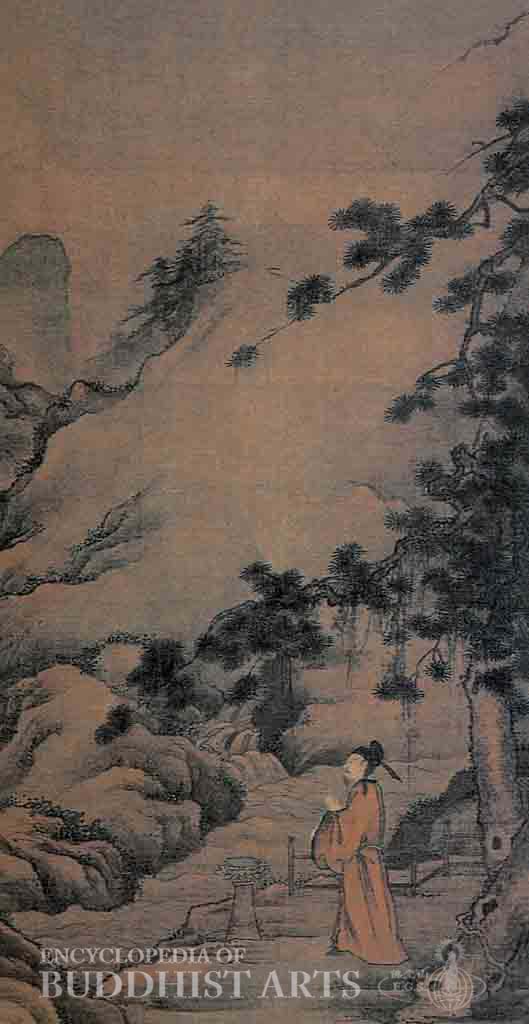
Illustrated Buddhist Teachings - Hermit
Ink and color on silk
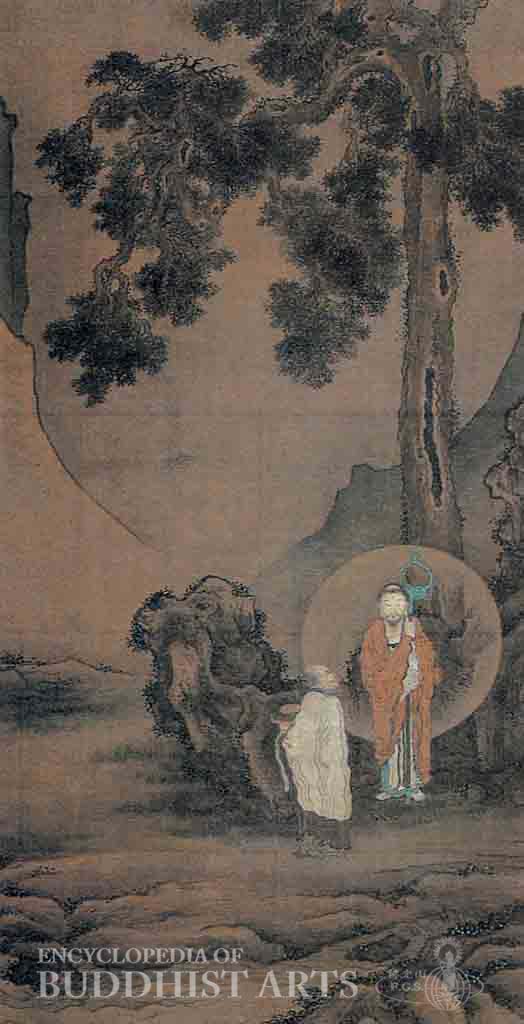
Illustrated Buddhist Teachings - Sakyamuni Buddha and Disciple
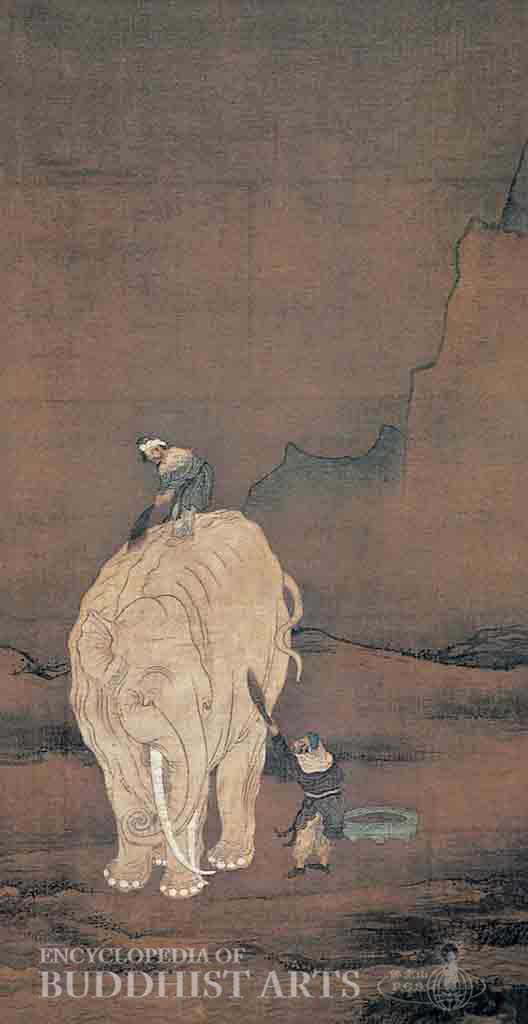
Illustrated Buddhist Teachings - Washing the Elephant
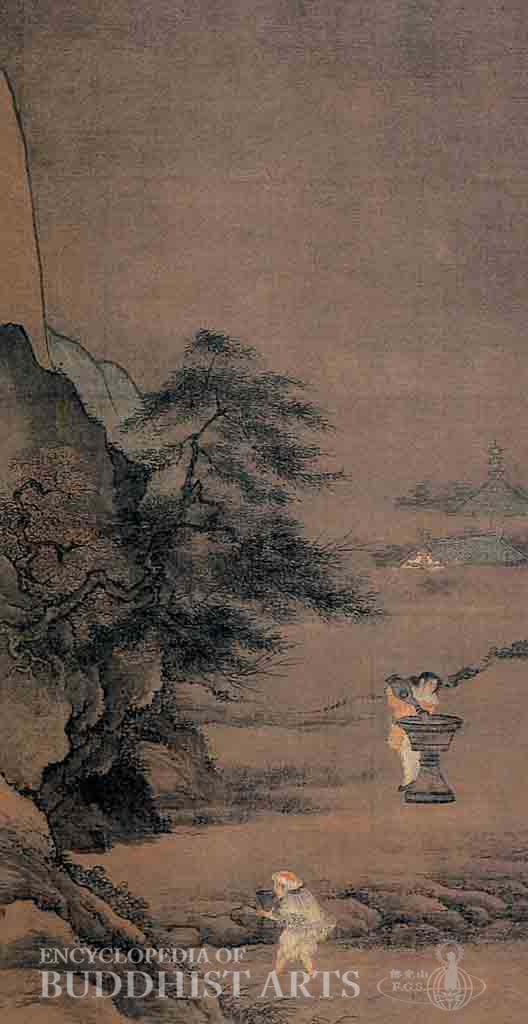
Illustrated Buddhist Teachings - Fetching Water
Illustrated Buddhist Teachings
CHINA; Ming dynasty
This set of four paintings, all with similar backgrounds of mountains and trees, illustrates different Buddhist teachings and practices. The first painting depicts a hermit dressed in red standing under a cypress tree. The relatively small figure of the hermit painted in the corner of the mountain landscape emphasizes the humility and vastness of mind that can be developed through ascetic practice. In the second painting, Sakyamuni Buddha, dressed in a red monastic robe, stands with a monk’s staff in hand and is accompanied by a disciple wearing a white robe. The third painting, Washing the Elephant, is based on the Diamond Sutra, which states that all form is unreal and illusive, and that those who see all form as empty see the Buddha. The elephant in the painting represents form, and the washing of the elephant symbolizes letting go of attachment to form. The last painting shows two figures filling a large vessel with water. In the distance, two buildings stand partly hidden in the mist, with only their roofs visible. Several paintings similar to these ones were produced during the Song (960–1279) and Yuan (1271–1368) dynasties. The artworks in extant are Washing the Elephant by Ding Yunpeng and Cui Zizhong.
For more details, go to the Encyclopedia of Buddhist Arts: Painting I-O, page 352.
Cite this article:
author = Hsingyun and Youheng and Youlu and Wilson, Graham and Manho and Mankuang and Huntington, Susan,
booktitle = {Encyclopedia of Buddhist Arts: Painting I-O},
pages = 352,
title = {{Illustrated Buddhist Teachings}},
volume = 15,
year = {2016}}