
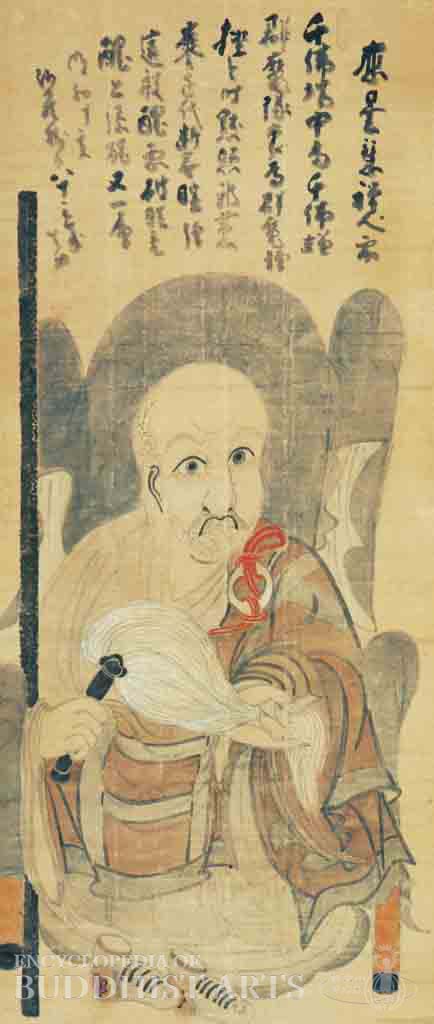
Self-Portrait by Hakuin Ekaku; Edo period, dated 1767
Ink and color on paper
Hakuin Ekaku
JAPAN, Shizuoka; Edo period
Hakuin Ekaku was born Sugiyama Iwajiro in Suruga (present day Shizuoka). He was also known as Korin and was posthumously titled Zen Master Shinki Dokumyo and National Master Shoju. Hakuin was a monk ordained at the age of 15 at Shoinji Temple in Shizuoka, where he would later serve as the abbot. He also received Dharma transmission from Zen Master Dokyu Etan of Shojuan Temple in Nagano.
Hakuin is famously known as the creator of the best-known Japanese koan, or gong’an: “What is the sound of one hand clapping.” He is also attributed with spearheading the revival of the Rinzai school of Zen Buddhism in Japan. Although he was popular for his unique insights and teaching methods, Hakuin shunned fame and traveled around the country teaching the Dharma. During this time, he began painting and creating works of calligraphy. From the age of 60 onward, he expressed his Zen concepts through art. His works are imbued with penetrating vigor and jest, revealing an amusing and juvenile appeal. Hakuin painted portraits of famous Zen masters in a caricature style with delicately stroked faces and bright and piercing eyes, fully conveying the austerity of Zen tradition.
Among Hakuin’s extant works is his Self-Portrait, which bedecked with his calligraphy. In the image, combinations of intense hues are intertwined with lighter shades. His overall palette is crisp. The portrait is currently collected in Ryutakuji Temple in Shizuoka. In addition, his famous depiction of Bodhidharma can be found in a number of temples around Japan. He painted vibrant images of Zen Masters Nampo Jomyo, Shuho Myocho, and Kanzan Egen, the first three patriarchs of the Rinzai school, the paintings collectively known as Otokan are currently kept at Daihoji Temple in Nagano. Bodhidharma on a Reed is now in the collection of Ryuunji Temple in Tokyo, and his calligraphic works include Zen Verse by Kanzan Egen and Dialogue Between Masters Tansheng and Weishan.
For more details, go to the Encyclopedia of Buddhist Arts: People, page 87.
Cite this article:
author = Hsingyun and Youheng and Youlu and Pokorski, Stefanie and Yichao and Mankuang and Miaohsi,
booktitle = {Encyclopedia of Buddhist Arts: People },
pages = 87,
title = {{Hakuin Ekaku}},
volume = 19,
year = {2016}}