
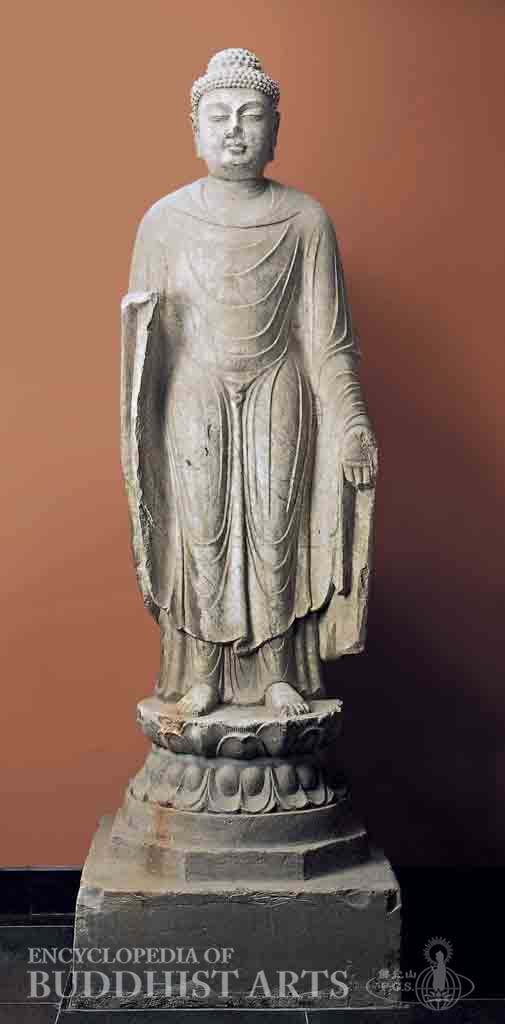
Standing Buddha
Stone
Standing Buddha
CHINA; Tang dynasty
This Buddha statue from Early Tang period (618–712) has square features and a mounded usnisa. The monastic robe covers both shoulders and falls deeply over the arms, spreading out the material that otherwise clings to the body. The folds follow and emphasize the shape of the limbs particularly in the way they divide over either thigh and ripple separately down the legs in a pattern that is mirrored by the lower robe. The left hand hangs downward in varada (wish-granting) mudra. The double lotus pedestal on which the figure stands is not the original, but from the earlier Northern Zhou dynasty, as is attested by an inscription dated 560.
For more details, go to the Encyclopedia of Buddhist Arts: Sculpture St-Z, page 1136.
Cite this article:
Hsingyun, et al. "Standing Buddha." Encyclopedia of Buddhist Arts: Sculpture St-Z, vol. 13, 2016, pp. 1136.
Hsingyun, Youheng, Yann Lovelock, Yuan Chou, Susan Huntington, Gary Edson, and Robert Neather. 2016. "Standing Buddha" In Encyclopedia of Buddhist Arts: Sculpture St-Z, 13:1136.
Hsingyun, Youheng, Lovelock, Y., Chou, Y., Huntington, S., Edson, G., & Neather, R.. (2016). Standing Buddha. In Encyclopedia of Buddhist Arts: Sculpture St-Z (Vol. 13, pp. 1136).
@misc{Hsingyun2016,
author = Hsingyun and Youheng and Lovelock, Yann and Chou, Yuan and Huntington, Susan and Edson, Gary and Neather, Robert,
booktitle = {Encyclopedia of Buddhist Arts: Sculpture St-Z},
pages = 1136,
title = {{Standing Buddha}},
volume = 13,
year = {2016}}
author = Hsingyun and Youheng and Lovelock, Yann and Chou, Yuan and Huntington, Susan and Edson, Gary and Neather, Robert,
booktitle = {Encyclopedia of Buddhist Arts: Sculpture St-Z},
pages = 1136,
title = {{Standing Buddha}},
volume = 13,
year = {2016}}