
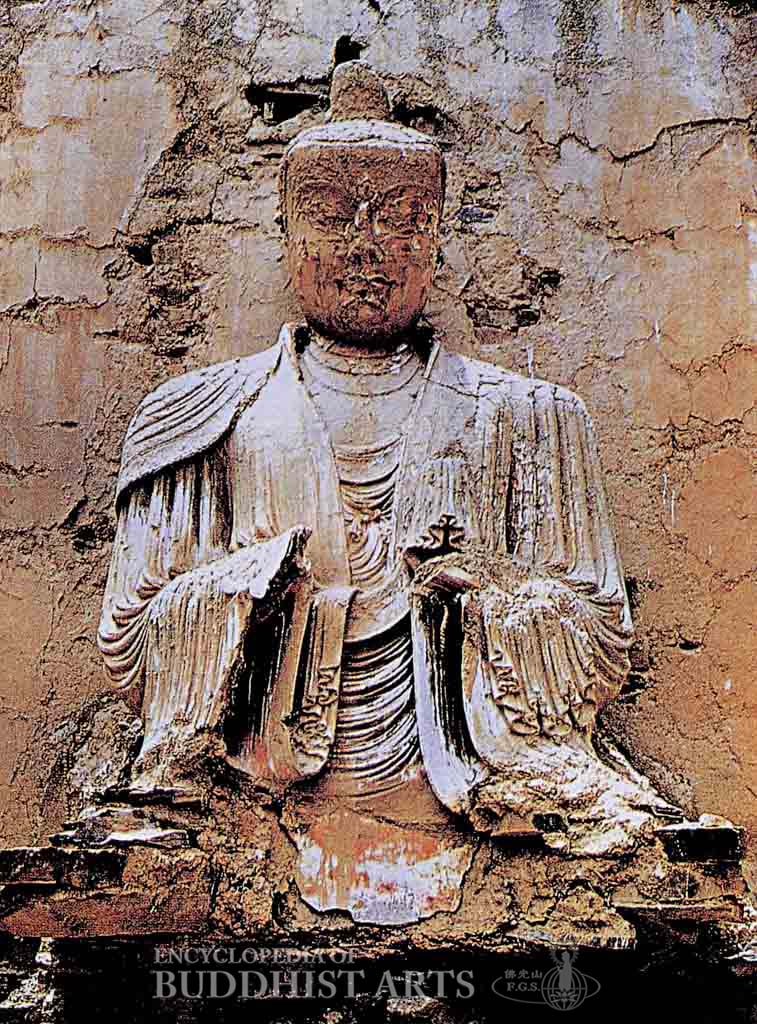
Yemar Monastery Amoghadarsana Hall: Amoghadarsana Buddha
Clay
Yemar Monastery Amoghadarsana Hall: Amoghadarsana Buddha
CHINA, Tibet, Shigatse
The statue is located in the Amoghadarsana Hall at Yemar Monastery. Molded in stucco and larger than life-size, the figure has a large forehead, well defined eyebrows, a narrow nose bridge and a broad mouth. The intricate folds of the robes are meticulously executed. Though the raised hands and lower body are missing, it is believed that the Buddha was originally seated with legs crossed. The gentle patterns in the flowing lines of the robes are a unique feature of the monastery’s sculptures. Sculptures from the Yemar Monastery show both the Dunhuang and Khotan styles.
For more details, go to the Encyclopedia of Buddhist Arts: Sculpture St-Z, page 1404.
Cite this article:
Hsingyun, et al. "Yemar Monastery Amoghadarsana Hall: Amoghadarsana Buddha." Encyclopedia of Buddhist Arts: Sculpture St-Z, vol. 13, 2016, pp. 1404.
Hsingyun, Youheng, Yann Lovelock, Yuan Chou, Susan Huntington, Gary Edson, and Robert Neather. 2016. "Yemar Monastery Amoghadarsana Hall: Amoghadarsana Buddha" In Encyclopedia of Buddhist Arts: Sculpture St-Z, 13:1404.
Hsingyun, Youheng, Lovelock, Y., Chou, Y., Huntington, S., Edson, G., & Neather, R.. (2016). Yemar Monastery Amoghadarsana Hall: Amoghadarsana Buddha. In Encyclopedia of Buddhist Arts: Sculpture St-Z (Vol. 13, pp. 1404).
@misc{Hsingyun2016,
author = Hsingyun and Youheng and Lovelock, Yann and Chou, Yuan and Huntington, Susan and Edson, Gary and Neather, Robert,
booktitle = {Encyclopedia of Buddhist Arts: Sculpture St-Z},
pages = 1404,
title = {{Yemar Monastery Amoghadarsana Hall: Amoghadarsana Buddha}},
volume = 13,
year = {2016}}
author = Hsingyun and Youheng and Lovelock, Yann and Chou, Yuan and Huntington, Susan and Edson, Gary and Neather, Robert,
booktitle = {Encyclopedia of Buddhist Arts: Sculpture St-Z},
pages = 1404,
title = {{Yemar Monastery Amoghadarsana Hall: Amoghadarsana Buddha}},
volume = 13,
year = {2016}}