
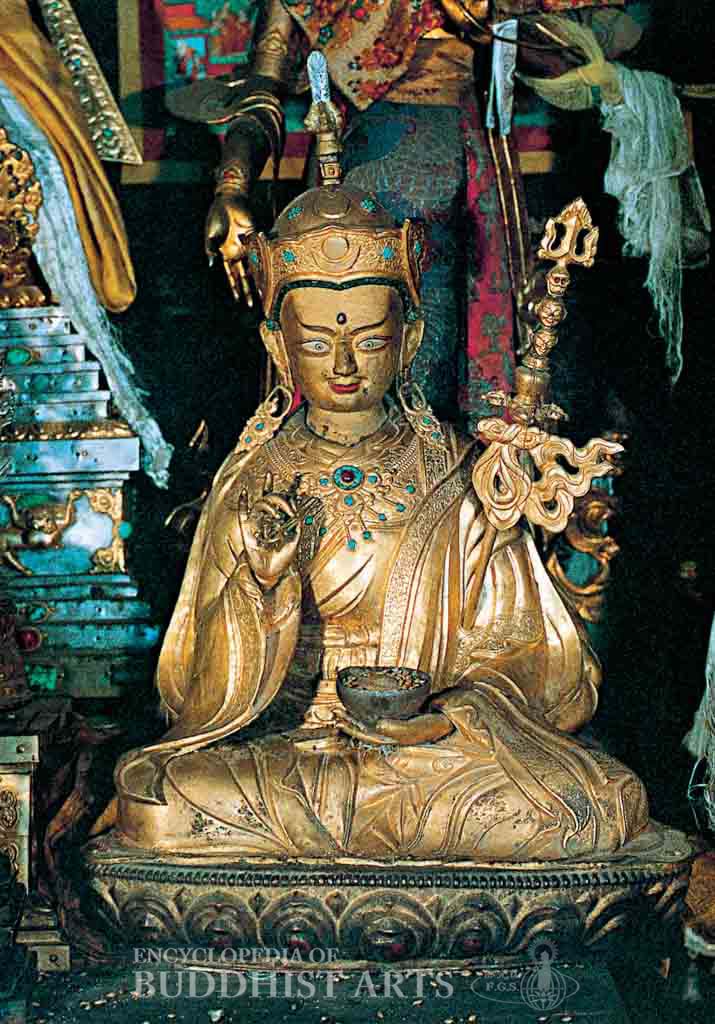
Shalu Monastery: Padmasambhava
Gilt copper alloy
Shalu Monastery: Padmasambhava
CHINA, Tibet, Shigatse
The statue was created during the 17th to 18th century. Padmasambhava has both peaceful and wrathful forms in iconographic terms and is portrayed here as a protector. The fingers of the right hand are arranged in the karana (warding off evil) mudra while holding a vajra. The left hand holds a skull-cap bowl, while a staff is cradled in the crook of that arm. A ritual cap decorated with sun and moon symbols is on the head. The cap is inlaid with turquoise, as are its side-pieces, the large earrings and the necklace.
The head is tilted slightly to one side. An urna is centered in the forehead above eyes that are fixed in concentration. The figure sits in full lotus position on a lotus throne and is dressed in a heavy, cross-collared gown with long sleeves and a floral hem. The gown is tightly fastened at the waist and overlaid with a monastic robe.
For more details, go to the Encyclopedia of Buddhist Arts: Sculpture N-Sr, page 1048.
Cite this article:
author = Hsingyun and Youheng and Lovelock, Yann and Chou, Yuan and Huntington, Susan and Edson, Gary and Neather, Robert,
booktitle = {Encyclopedia of Buddhist Arts: Sculpture N-Sr},
pages = 1048,
title = {{Shalu Monastery: Padmasambhava}},
volume = 12,
year = {2016}}