
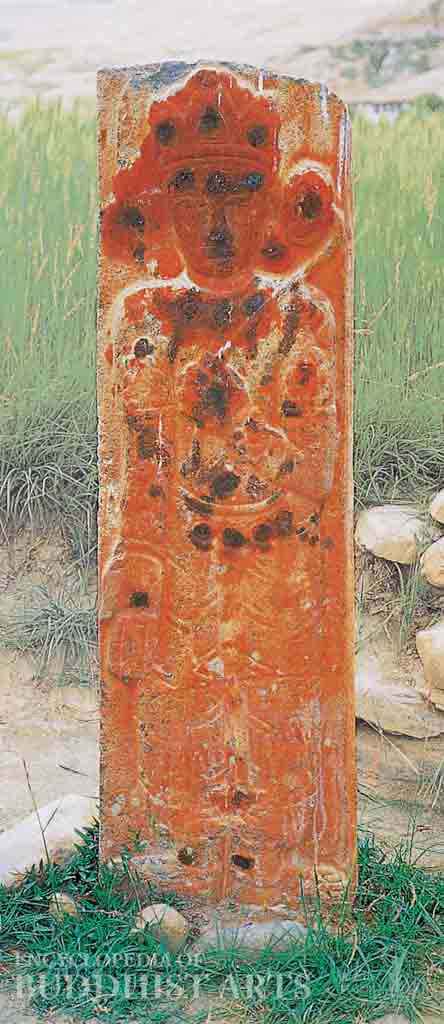
Burang: Padmapani Avalokitesvara
Granite
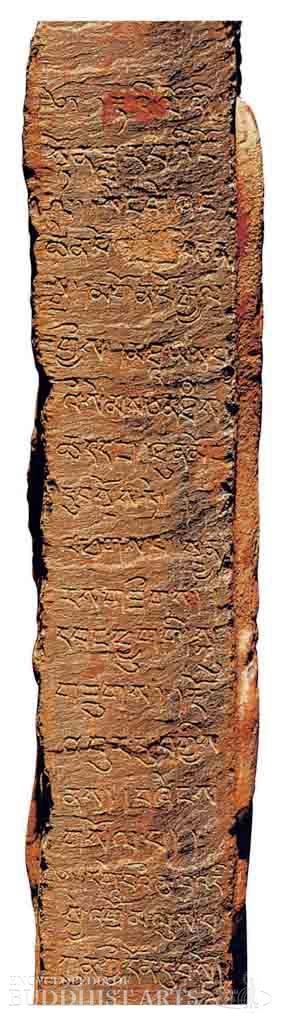
Burang: Padmapani Avalokitesvara (side)
Burang: Padmapani Avalokitesvara
CHINA, Tibet, Ngari
This stele is the only stone carving of Avalokitesvara made during the Tibetan Empire (circa 7th–9th century) that still remains in Tibet. The stele is 20 cm deep and inscribed in the ancient Tibetan script. The inscription on the right side indicates the stele was commissioned by a Tibetan person. The style of writing with the inscription confirms the carving was made between the ruling years of Trisong Detsen (reigned 755–797) and Ralpacan (reigned 814–838). It is possible that the donors were members of the royal family.
The front of the stele features Padmapani in a primitive form. The Bodhisattva wears a three-leaf crown of early Tibetan style, different from the popular five-leaf crown of later periods. The right hand is lowered in the varada (wish-granting) mudra while the left hand holds a long-stalked lotus. The figure wears a long skirt and stands with feet unnaturally askewed.
For more details, go to the Encyclopedia of Buddhist Arts: Sculpture A-F, page 228.
Cite this article:
author = Hsingyun and Youheng and Lovelock, Yann and Chou, Yuan and Huntington, Susan and Edson, Gary and Neather, Robert,
booktitle = {Encyclopedia of Buddhist Arts: Sculpture A-F},
pages = 228,
title = {{Burang: Padmapani Avalokitesvara}},
volume = 10,
year = {2016}}