
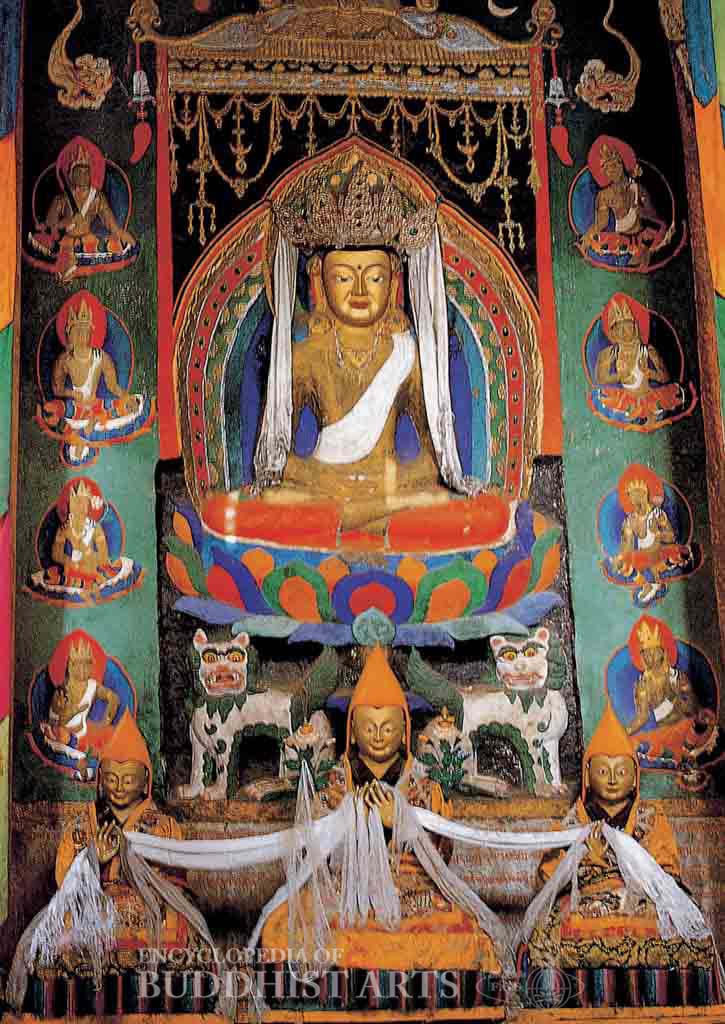
Renda: Vairocana Buddha and the Eight Great Bodhisattvas
Renda: Vairocana Buddha and the Eight Great Bodhisattvas
CHINA, Tibet, Qamdo; Tibetan Empire
These statues are enshrined in Qamdo, Tibet. According to the stone inscription, the sculptures were completed in 804 by Tibetan monks to praise the virtues and pray for longevity of the Tibetan king.
The niche dedicated to Vairocana Buddha has a total height of 3.3 m, while the figure itself has a height of 1.95 m. The Buddha’s exposed upper body is adorned with a long red garment and decorated with earrings and ornaments. He wears a crown and is seated on a lotus throne in full lotus position, with his hands forming the dhyana (meditation) mudra. A pair of white lions with green manes stand back to back below the throne. A peach-shaped mandorla is behind the Buddha, while a canopy is above him. An apsara sitting upon a cloud is depicted on both sides of the canopy.
Eight Bodhisattvas seated on lotus thrones are located on the borders. The Bodhisattvas wear trefoil crowns and their long hair falls down onto the shoulders. They are ornamented with necklaces, bracelets, armlets, and stoles. Long dhotis cover the lower bodies. All the Bodhisattvas have nimbuses. About 80 illegible Chinese characters are on the lower left section of the Buddha; a hand-written ancient Tibetan inscription consisting of 31 rows is legible at the lower left section of the throne.
For more details, go to the Encyclopedia of Buddhist Arts: Caves Mo-S, page 1334.
Cite this article:
author = Hsingyun and Youheng and Johnson, Peter and Mankuang and Huntington, Susan and Edson, Gary and Neather, Robert,
booktitle = {Encyclopedia of Buddhist Arts: Caves Mo-S},
pages = 1334,
title = {{Renda: Vairocana Buddha and the Eight Great Bodhisattvas}},
volume = 8,
year = {2016}}