
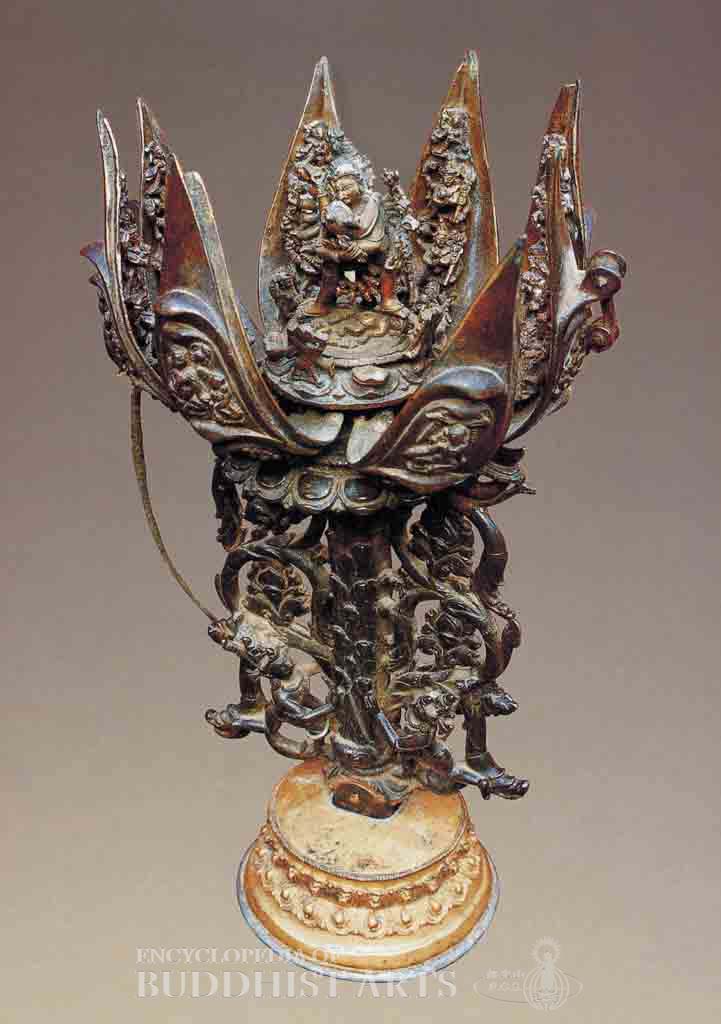
Zetho Monastery: Mandala of Kalacakra
Gilt copper alloy
Zetho Monastery: Mandala of Kalacakra
CHINA, Tibet, Qamdo; Ming dynasty
This mandala is in the form of a lotus. The base is round and consists of an inverted lotus with bead decorations. Arising from the base, there is a thick lotus stem which branches outwards. In the lower section, there are two heavenly beings making offerings, and on top of the lotus stem, there is an inverted lotus pedestal. The top section is composed of eight lotus petals forming a lotus bud when closed. When the petals are opened, Kalacakra is revealed. He is embracing his consort, Visvamata, while holding Dharma objects, such as a vajra and bell. The deity stands in pratayalidha posture with a spirit underneath his feet. On the interior of each lotus petal, there is a sculpture of his family members in high relief.
Such lotus mandalas with opening petals were prevalent during the Ming (1368–1644) and Qing (1644–1911) dynasties.
For more details, go to the Encyclopedia of Buddhist Arts: Artifacts, page 385.
Cite this article:
author = Hsingyun and Youheng and Youji and Pokorski, Stefanie and Mankuang and Fan, Wen,
booktitle = {Encyclopedia of Buddhist Arts: Artifacts },
pages = 385,
title = {{Zetho Monastery: Mandala of Kalacakra}},
volume = 18,
year = {2016}}